
Steel Toes & Plaid
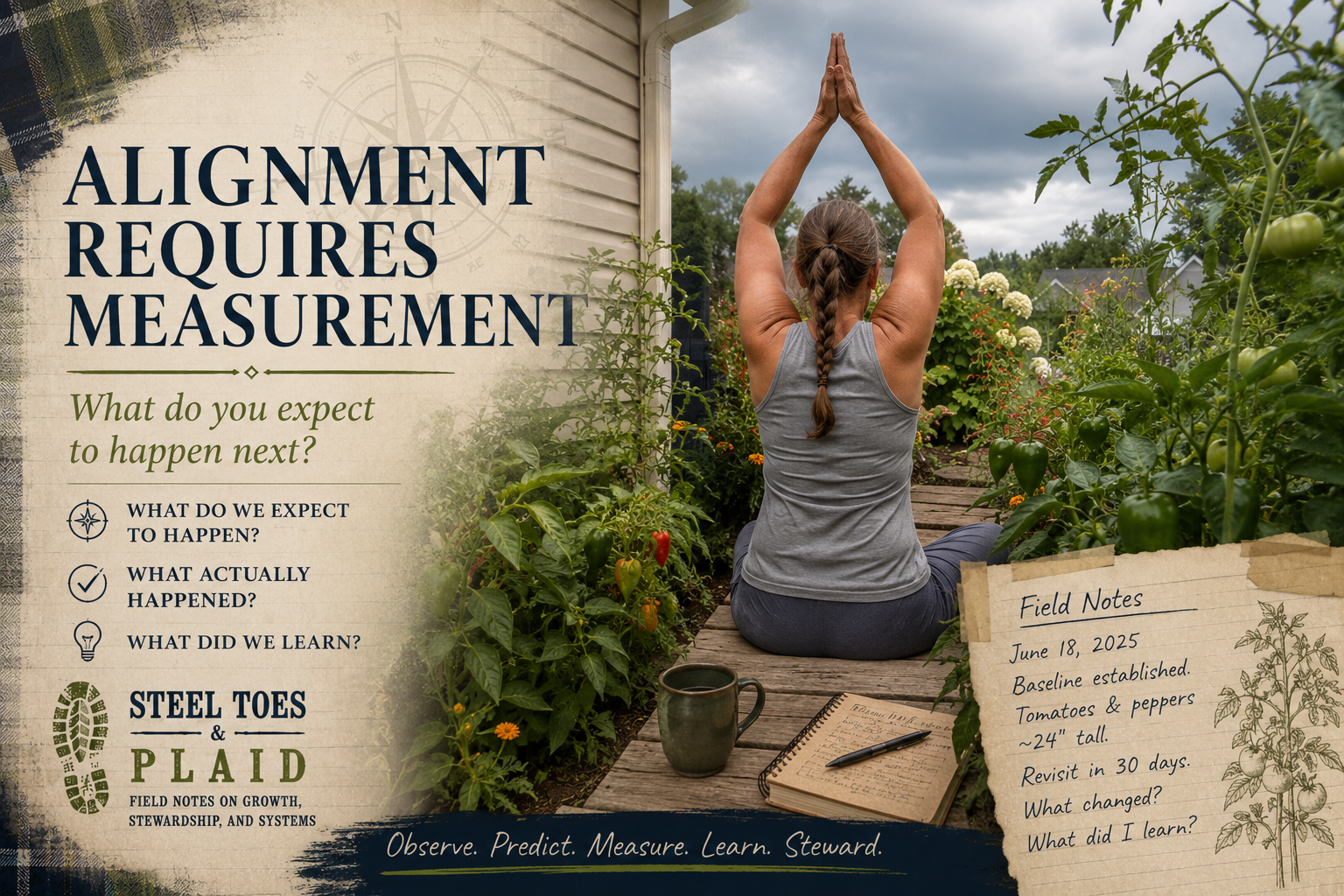
This morning I sat between the tomatoes and peppers and took a picture.
At first glance, it looks like a yoga photo.
It isn’t.
It’s a prediction.
One of my favorite coaching questions is simple:
What do you expect to happen next?
Later, we come back and ask two more questions.
What actually happened?
What did we learn?
Those three questions have guided much of my work over the years.
They help teams improve.
They help leaders grow.
They help organizations learn.
And they work surprisingly well in a garden.

When I took these pictures, I wasn’t trying to capture a beautiful moment.
I was establishing a baseline.
I wanted evidence.
Not because something is wrong.
Because things are changing.
The tomatoes next to me are growing.
The peppers are growing.
The flowers are growing.
The entire garden is growing.
In fact, if everything goes according to plan, there’s a good chance I won’t even be able to sit in that exact spot a month from now.
The plants will be larger.
The pathways will be different.
The space will have changed.
The wooden platform I’m sitting on may not even be there anymore.
That is my prediction.
Now I get to find out what actually happens.

The interesting part is that the plants aren’t the only thing being measured.
So am I.
A month from now I want to compare these photos.
I want to see the garden.
But I also want to see myself.
My posture.
My alignment.
My shoulder position.
My muscle tone.
My core strength.
My skin tone.
My balance.
My range of motion.
Not because I’m chasing perfection.
Because I’m curious.
Because evidence matters.
Because memory is often a poor measuring system.
The changes we experience every day are often too small to notice while they’re happening.
A photograph allows us to see what daily familiarity hides.
This is one of the reasons I believe technology can be such a powerful tool when used intentionally.
A photograph.
A journal.
A time-lapse.
A simple note in a notebook.
None of these things create growth.
They reveal it.
They help us see patterns that would otherwise be invisible.
And once we can see a pattern, we can learn from it.
The same principle applies far beyond a garden.
Health.
Wellness.
Families.
Leadership.
Businesses.
Teams.
Communities.
The question remains the same.
What do we expect to happen?
Then later:
What actually happened?
What did we learn?
Without those questions, growth often feels random.
With them, growth becomes observable.
And when growth becomes observable, it becomes easier to nurture.
The garden is teaching me that stewardship is not control.
Stewardship is attention.
It is creating conditions where healthy growth is more likely to occur.
Not just for ourselves.
For others.
For families.
For teams.
For communities.
For future versions of ourselves.
The vegetables don’t grow because I demand it.
They grow because I create an environment that supports it.
People are often the same.
When I look at these photos, I don’t see yoga.
I see a baseline.
I see an experiment.
I see a future comparison.
I see a question waiting for an answer.
And a month from now, when the garden has changed and hopefully I have too, I’ll take another picture.
Then I’ll ask the same questions again.
What did I expect?
What actually happened?
What did I learn?
That’s how gardens grow.
That’s how people grow.
And that’s how stewardship becomes visible.