
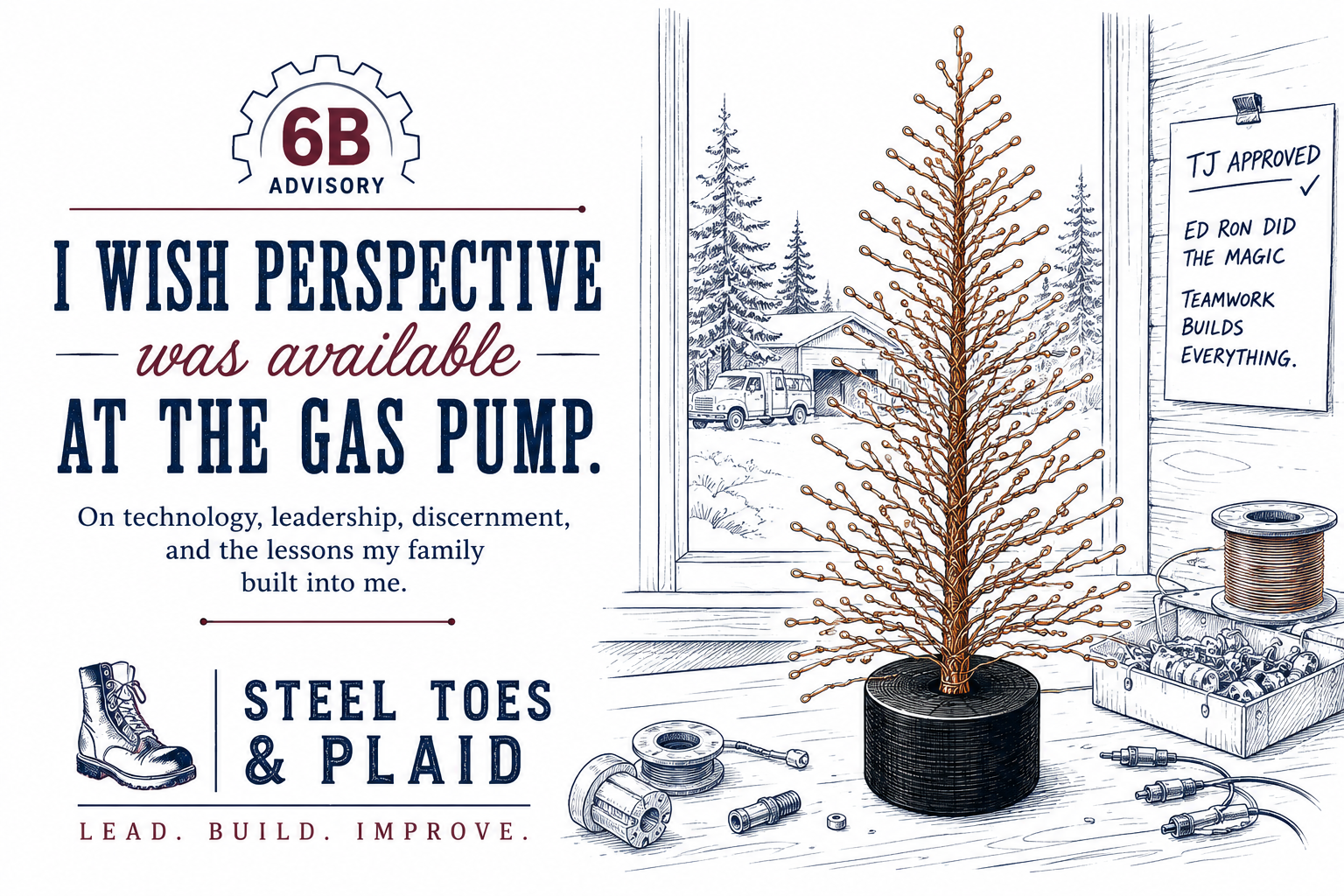

One of my favorite things to say is:
“I wish perspective was available at the gas pump.”
People usually smile.
What they don’t know is that the saying probably came from the way I grew up.
My family spent their lives building, repairing, and maintaining the infrastructure beneath gas stations. Underground fuel storage systems. Electrical controls. Construction. Service. Convenience stores. Marinas. If there was work to be done, chances are someone in my family knew how to do it.
It wasn’t just my dad.
It was my mom, my grandfather, aunts, uncles, cousins, family friends. It was weekends, summers, road trips, hotels, campers, construction sites, and conversations that somehow always found their way back to work.
Before I was old enough for school, spending weeks on the road with my family wasn’t unusual.
That world shaped me.
Growing up, I learned something most people never think about.
The most important parts of a gas station are the parts you never see.
The pipes.
The tanks.
The electrical systems.
The safety systems.
Everything beneath your feet has to work flawlessly before you ever squeeze the handle.
I’ve come to believe people are a lot like that.
The work beneath the surface matters most.
My dad, especially, had a fascination with technology.
Long before most people talked about digital transformation, he was paying attention to how technology was changing the fuel industry. Encryption. Electronic payment systems. Secure communication between pumps and point-of-sale systems. He understood that technology wasn’t simply changing equipment.
It was changing how people worked.
How businesses operated.
How society functioned.
As a kid, I didn’t understand all of it.
What I understood was this:
Pay attention.
Technology is going to keep changing.
Don’t be afraid of it.
Understand it.
I can still remember sitting in the garage learning to solder circuit boards long before I ever learned to weld.
Power tools weren’t intimidating.
Electrical components weren’t mysterious.
They were simply another way to solve problems.
Dad taught me that.
He also taught me that the people using the technology mattered just as much as the technology itself.
Looking back, I realize those lessons never left.
They followed me into manufacturing.
Into continuous improvement.
Into leadership.
Into consulting.
And now, into conversations about artificial intelligence.
Lately I’ve watched people shame one another over AI.
Artists.
Writers.
Designers.
Business owners.
Sometimes the criticism comes from people using platforms that rely heavily on AI themselves.
Sometimes it comes from people I genuinely respect.
I understand the concerns.
I share many of them.
As someone who cares deeply about conservation, I think we should be asking hard questions about energy, resources, and long-term sustainability.
As someone who values artists, I continue supporting local creators whenever I can.
None of that changed when AI entered the conversation.
What did change was my own life.
For more than a year, my health took away abilities I had always taken for granted.
My hands.
My eyes.
My stamina.
Writing became harder.
Creating became harder.
Building a business became harder.
Artificial intelligence didn’t replace my voice.
It helped me keep using it.
It became one bridge between where I was and where I’m trying to go. That’s a “Slingshot Design”, by my own definition.
Even then, I wanted to use it intentionally.
I keep my graphics simple.
I generate multiple illustrations together whenever practical instead of creating them one at a time.
I avoid endless iterations simply because I can.
I continually look for ways to reduce my dependence on AI rather than increase it.
In fact, one of the most interesting things I’ve done over the past year is use AI to help me rely less on AI.
Today, I capture my thoughts using Apple’s built-in tools, organize them more efficiently than I could before, and gradually shift more of my workflow into technologies I already use every day.
My goal has never been dependence.
It’s been discernment.
That’s the word I keep coming back to.
Discernment.
Not fear.
Not blind optimism.
Not shame.
Discernment.
Every generation faces technologies that reshape the way we live and work.
The automobile.
Electricity.
Computers.
The internet.
Automation.
Artificial intelligence.
None of these changes arrived without uncertainty.
None arrived without opportunity.
Leadership has never been about pretending change isn’t happening.
Leadership is deciding how we’ll respond when it does.
Years ago, I worked in organizations where I watched automation become a reason to eliminate people.
I couldn’t reconcile that with my values.
I left.
Because I have always believed something different.
If technology removes repetitive work, our responsibility isn’t to discard the people doing it.
It’s to help them grow into the work that’s now possible.
Some of my favorite people to teach have always been machine operators.
They’re already experts.
They understand the equipment.
They understand the process.
Given the opportunity, they become outstanding troubleshooters, mentors, and problem-solvers.
That’s what investing in people looks like.
The same principle applies today.
Artificial intelligence shouldn’t replace our humanity.
It should create more space for it.
More creativity.
More critical thinking.
More curiosity.
More meaningful conversations.
If it isn’t doing that, then we’re probably solving the wrong problem.
Maybe that’s why I still wish perspective was available at the gas pump.
Not because it would settle every disagreement.
But because it might remind us to pause before judging someone else’s decisions.
We rarely know what they’re carrying.
We rarely know what they’re rebuilding.
We rarely know the invisible systems beneath the surface that made today’s choice the best one they could make.
Perspective doesn’t come from a gas pump.
It comes from curiosity.
It comes from humility.
It comes from remembering that every new tool eventually becomes ordinary.
Our character never should.
Dad, thank you.
Thank you for teaching me not to fear technology.
Thank you for teaching me to understand it.
More importantly, thank you for teaching me that no matter how advanced our tools become, they’re still only tools.
The future has always belonged to people willing to learn, willing to adapt, and willing to use what they’ve been given responsibly.
I hope I’ve made you proud.
And I hope I always will.
❤️