
Sometimes the value was never in the outcome. Sometimes the value is in learning to see what was already there.
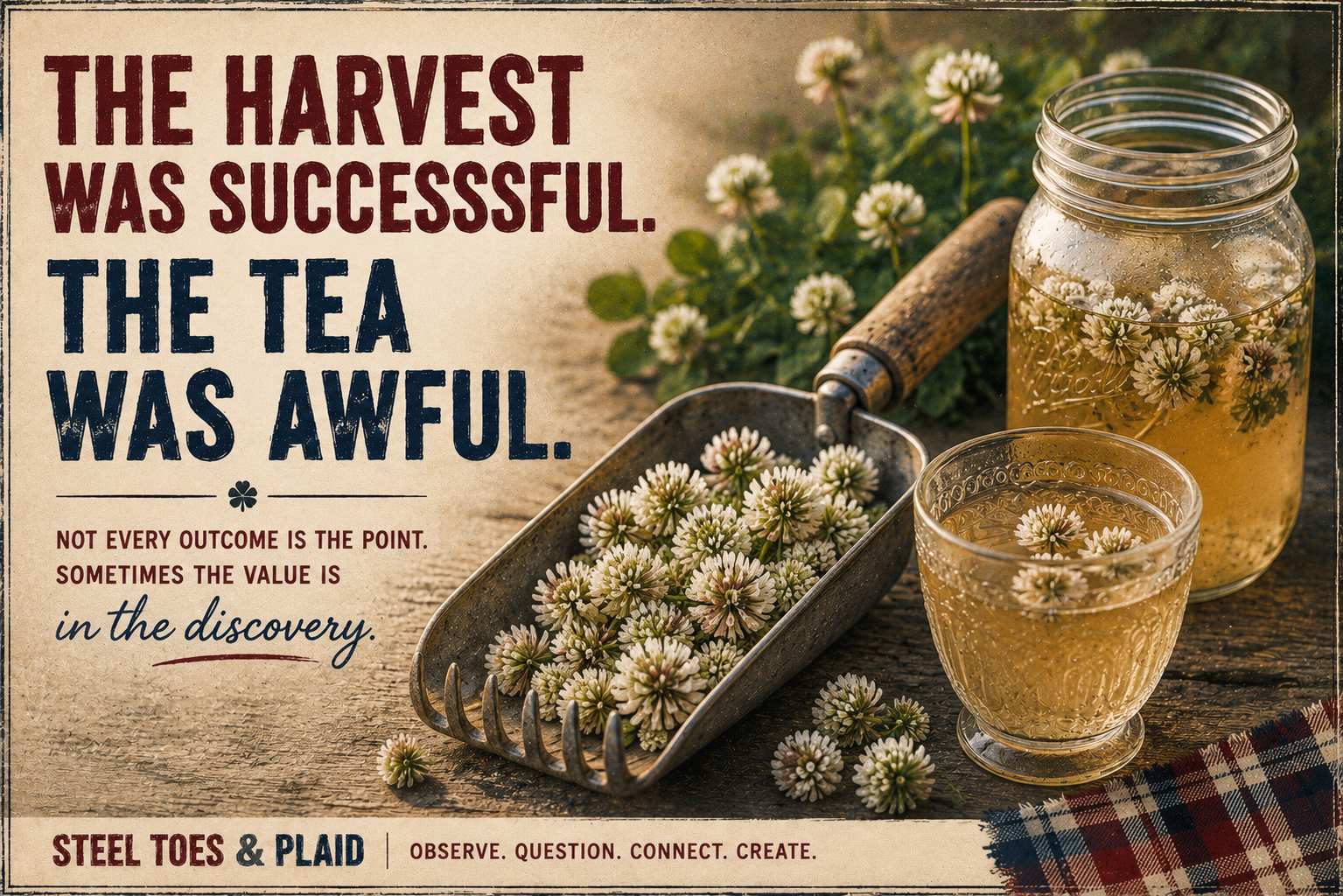
A few weeks ago, I came across a harvesting tool designed for collecting delicate blossoms like chamomile and clover.
I couldn’t wait to try it.
Not because I had a pressing need for clover tea. Not because I was searching for a new hobby. I simply saw a tool that solved a problem in an interesting way, and I wanted to see what it could do.
So I headed into the yard and began harvesting.
The process was beautiful.
The small white blossoms filled the scoop effortlessly. The photographs turned out better than I expected. The project sparked conversations around the house. Everyone wanted to know what I was making.
I followed the recipe exactly.
I brewed the tea.
I paired it with a floral peony syrup I had made earlier in the season. The syrup smelled like warm honey and summer gardens.
The finished drink looked lovely.

The tea tasted terrible.
Not mildly disappointing.
Not something I would tweak and try again.
Terrible.
I genuinely could not finish the glass.
At first glance, that sounds like a failed experiment.
The tea was the intended outcome, after all.
Except that’s not what happened.
The harvest was successful.
The tool worked beautifully.
The process was enjoyable.
The photographs were worth taking.
The conversations were worth having.
The curiosity was worth following.
The only thing that failed was my assumption that the value of the experience depended on the tea.
That realization stayed with me longer than the taste.
Before this experiment, I saw clover as an environmentally friendly alternative to traditional lawns.
It supports pollinators.
It requires less maintenance.
It helps keep the ground cooler.
Useful information.
After the experiment, I saw something different.
I saw a resource.
I saw possibility.
I saw a plant I knew almost nothing about despite walking past it every day.
The lawn hadn’t changed.
I had.
I now knew something about clover that I hadn’t known before. I had touched it, harvested it, brewed it, tasted it, and learned from it.
I had moved from assumption to experience.
I’ve seen this same pattern throughout my life.
An employee who wasn’t the right fit for the role they were hired into may still possess extraordinary talent.
A new technology may fail in one application and create an entirely new market in another.
A creative project may refuse to become what we originally intended, only to reveal something more interesting along the way.
The people, tools, and ideas around us often contain far more potential than we initially recognize.
The challenge is not finding value.
The challenge is seeing it.
Curiosity helps.
Play helps.
Experimentation helps.
The willingness to interact with something long enough to discover what it actually is rather than what we expected it to be helps most of all.
If I had known beforehand that the tea would taste awful, I still would have harvested the clover.
Not because I wanted the tea.
Because I wanted to see what the tool could do.
Because I wanted to learn something new.
Because curiosity is often valuable long before it becomes useful.
What surprised me most wasn’t that the tea tasted bad.
It was what happened afterward.
I looked across the yard differently.
What had once been ground cover became a resource.
What had once been a familiar plant became an ingredient.
What had once been part of the landscape became a source of possibility.
Nothing about the clover changed.
My relationship to it did.
Perhaps that’s the lesson.
Sometimes we think we’re creating a product when we’re really creating knowledge.
Sometimes we think we’re pursuing an outcome when we’re actually building a relationship with the process.
Sometimes we think we’re making tea.
When what we’re really doing is learning to see what was already there.
Steel Toes & Plaid
Observe. Question. Connect. Create.