
Learning to live without urgency making every decision
I caught myself wanting all the juicy details.
Tell me what happened. What did they say? What did you say back? Then what?
Someone in my family would be telling me about their day, and my mind would get to work. Examining. Connecting. Looking for the problem and assembling possible solutions.
I knew how to do that.
I had spent months doing exactly that in my own life.
What I was having trouble doing was simply listening to someone I loved without moving us along to a resolution.
That was one of the ways I discovered the space between surviving and thriving.
I had a little room.
I didn’t yet know what to do with it.
My mind was still moving at crisis speed
In Writing Through Turbulence, I wrote about recognizing survival mode when you still look highly capable.
You can keep producing. Keep showing up. Keep handling things.
And you can become very practiced at handling things.
When my life became deeply disrupted, there were real problems that required my attention. I recognized enough of the terrain to know I couldn’t wait for everything to blow over.
There were conversations I didn’t want to have. Decisions I didn’t want to make. Things I should never have had to address.
But they were there.
So I addressed them.
Some of that work involved making sense of what had happened. Timelines. Details. Going back through information. Separating what I knew from what I suspected and what I still couldn’t explain.
That kind of work consumes attention.
Eventually, I had enough clarity to make decisions and begin moving forward. There was still healing to do—physically, emotionally, spiritually—but every moment no longer required another investigation.
My mind, however, was still reporting for duty.
What are we solving today?
Who needs help?
What did we miss?
And when I didn’t deliberately consider where to put that attention, it found somewhere to go.
Frequently, somewhere very close to home.
Listening had become fixing
I care about my children. I care about my husband. I want to know what is happening in their lives.
But I began catching a difference between being interested and getting involved.
Sometimes I was taking information they shared and turning it into work they hadn’t asked me to do.
My mind would pick at it.
Have you considered this? What about that? Here’s what I would do.
Meanwhile, they might simply have been telling me about Tuesday.
That was uncomfortable to recognize.
I had been solving complicated problems in my own life for so long that I was bringing that same intensity into ordinary conversations. Their experiences gave my attention somewhere to go outside the work of figuring out my own next chapter.
I needed to notice when that was happening.
Was there actually something here that required my involvement?
Had anyone asked me to solve it?
Could I receive what this person was sharing and let them remain the person making the decisions?
Those questions brought me back to my own work.
I could care. I could listen. I could be available.
I could also stop.
We weren’t all moving at the same pace
This becomes especially noticeable inside a home.
One person is sprinting. Another is running a relay. Someone else is benched, trying to recover. Another person is simply out for a morning jog.
And somehow, everyone still needs dinner.
There were times when my pace and the pace of the people around me were very different.
That didn’t automatically mean we were falling apart.
It meant I needed to pay attention to the difference—and stop assuming that the urgency I felt belonged to everyone else.
Something could feel pressing to me without requiring an immediate response from the whole household.
I had to learn how to be with people without recruiting them into the speed at which my mind was moving.
Stillness became my priority
I knew I couldn’t return to what I had been doing in the same way.
I also didn’t know what I was going to do next.
That is an uncomfortable combination for someone accustomed to figuring things out.
I could generate possibilities. Research them. Evaluate them. Create an entire plan before lunch.
But I needed to learn to be still again.
Stillness had to become a priority.
There could be 143 things on the list, with 75 of them waving their arms and insisting they were urgent.
That didn’t make them all equally urgent.
It certainly didn’t make them all mine.
In Just Because You Can, I wrote that capacity is not obligation.
This was where I had to practice it.
I needed to look at what I was carrying with fresh, rested eyes. What actually required my attention? What had I taken on because I knew how? What belonged to someone else? What needed help rather than more effort from me?
Our responsibilities deserve an honest review.
So do the arrangements that leave us responsible for everything.
I still believe in goals
I like measurable goals.
I have spent years helping people turn something vague and overwhelming into something concrete enough to act on.
“I need to get the house clean” can sit on a list for four years.
“I’m going to clear the dishes off these three counters by this afternoon” gives me a task I can understand and a finish I can recognize.
That kind of structure can be useful during recovery, too.
I can notice a behavior I want to change. Practice a different response. Look for evidence that something is becoming more manageable. Adjust when my capacity changes.
But I also have to know what the goals are helping me build.
Otherwise, I can spend months making bricks.
Good bricks. Carefully measured bricks. An impressive quantity of bricks.
Then find myself standing in the middle of all that masonry with no shelter.
What am I building?
What kind of life will these efforts support?
Does completing this task leave me with more room to live—or another reason to keep proving how much I can accomplish?
I needed goals that served the life I was trying to create.
And I needed some room in that life where nothing was being graded.
I went looking for myself
Eventually, I went back through my own things.
Hobbies. Journals. Papers I had kept. Notes. Things I had written and made.
There was a person in those artifacts I recognized.
I could see what had interested me. What I had returned to. What I cared enough about to preserve.
After spending so much time examining what had happened, I needed to remember more of the life around it.
Who had I always been?
What still interested me?
What might I want to try again?
Some of those attempts were frustrating.
Crocheting and sewing were things I knew how to do well, but my hands couldn’t participate in the same way anymore. Familiar arts and crafts required adaptations I hadn’t yet figured out.
Even writing needed a different approach.
So I began dictating.
I didn’t know at the beginning of this process that writing would become such an important part of what came next.
I thought maybe.
But I had to give myself room to find out.
Something to hold on to
In The Unraveling, I wrote:
I learned to loosen
what pulling only tightened.
That took practice. I still practice.
Perhaps you recognize yourself here.
You finally have a quiet afternoon, but you can’t settle into it. You’re exhausted, yet your mind keeps finding things that need your attention. Someone you love starts talking, and before they finish, you’re already working on what should happen next.
You know how to be useful.
You’re having trouble knowing what to do when nobody needs you to do anything—or when you need them to stop needing so much.
And when someone asks what you want to do, you draw a blank.
You can tell them what needs doing. You have a list.
What you want is a harder question.
Especially when the things you used to enjoy don’t fit your life, your body, or your circumstances the way they once did.
That is the space I’m talking about.
Yesterday, I wrote about recognizing the turbulence. But perhaps, for you, the plane has already hit the water.
Your arms are moving. You’re trying to keep your head above the surface. Someone calling, “You’ve got this!” from the shore doesn’t give you anything to hold on to.
You need something that floats.
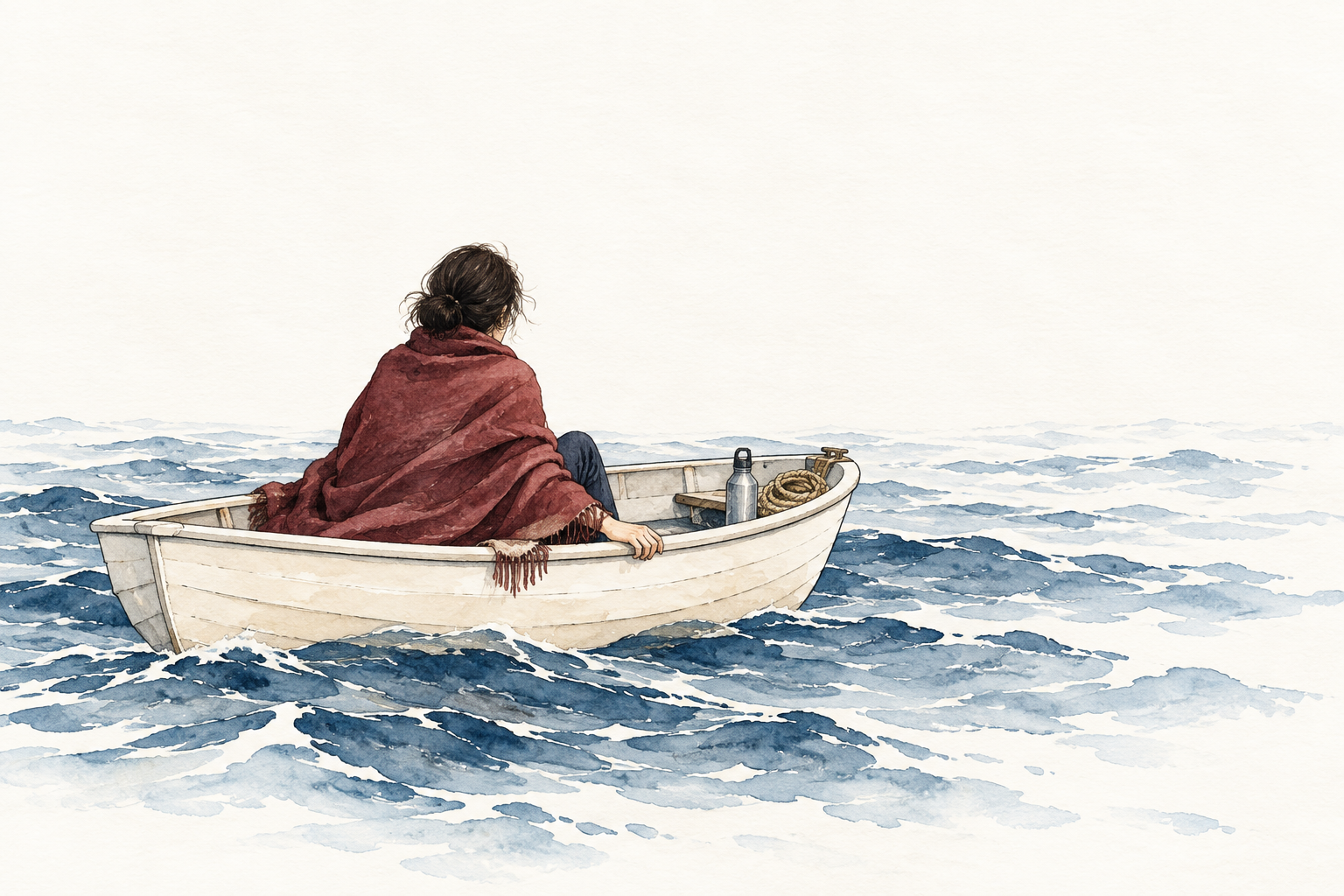
A dinghy. Enough support to stop spending everything you have on staying above water.
In ordinary life, that might mean someone taking a recurring responsibility all the way off your hands. Help with a task you can no longer manage the old way. A meal. A ride. A person who can sit beside you while you make the difficult call.
Something that changes how much you have to carry.

Then a compass and a map.
Where am I now? What is still available to me? What actually needs to happen next? Who can help me find a way through?
You don’t need to know your destination to benefit from knowing your current position.
You need rations, too. Food. Rest. Resources that last beyond one good afternoon. Support you can count on again tomorrow.
And hope needs somewhere to take hold.
Sometimes that begins with one thing becoming more manageable. One person following through. One task finding its way into somebody else’s capable hands.
Sometimes it begins when you discover that something you thought you had lost is still accessible through a different door.
I found dictation.
Your door may be something else entirely.
You’re allowed to look for it without knowing what will be on the other side.
For now, consider the thing that is consuming the most energy just to keep you afloat. What would make that one thing more manageable? Could somebody share it, take it over, or help you approach it differently?
Start there.
And when a little room opens up, see whether you can leave some of it available. You don’t have to assign every returning ounce of energy to another obligation.
That space is where you can begin noticing what interests you. What feels good. What you might like to try.

You may still be grieving. You may still have problems that require real attention. You can also begin gathering the materials for what comes next.
Something that catches your interest today may become part of your sail later.
You don’t have to build it while you’re still struggling to climb into the boat.