

Waking up these days is so different.
I never, in a million years, thought slowing down would be harder for me than getting motivated.
But it is.
It is infinitely easier for me to look at everything in front of me and say, I can just do it myself.
I know how to organize it. I know how to make it faster. I know how to eliminate the unnecessary steps, fix the process, tighten the handoffs and get it right the first time.
I spent most of my career learning how to do exactly that.
Continuous improvement.
And somewhere along the way, I applied the methodology to myself.
If I could fit 30 things into a day, surely I could figure out how to fit 35.
Then 40.
Then make the 40 easier so there was room for something else.
Faster. Stronger. More effectively. More efficiently.
Wonderful.
Except eventually I had to ask a question that never occurred to me while I was busy improving everything:
What exactly was the point?
Because eventually I had created a remarkably efficient operating system for overwhelming myself.
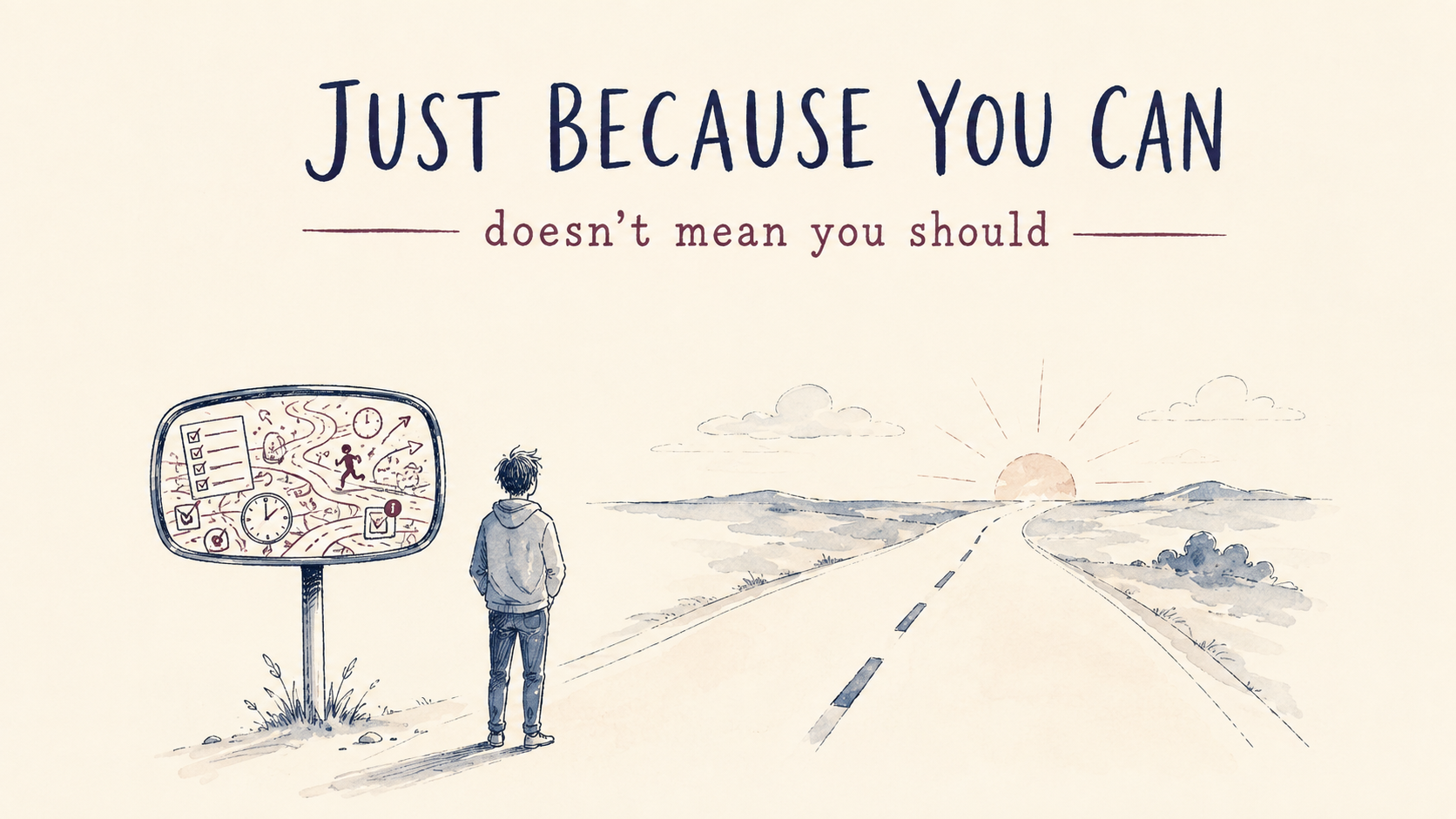
I had proven, over and over again, that I could.
That turned out to be very different from proving that I should.
And this year, perhaps more than any other time in my life, I have had to learn the difference.
Some days, by somebody else’s standards, I probably don’t look like I’m doing enough to need to slow down.
That’s the tricky part.
If I compare my capacity to someone else’s expectations—or even to an earlier version of myself—I can always find evidence that I could squeeze in one more thing.
For a lifelong overachiever, that almost feels like a dare.
You have room.
You could do more.
You’ve handled worse.
You know how.
Yes.
I do.
And that is precisely why I have had to learn to stop.
The Things We Teach Without Meaning To
This gets particularly uncomfortable when you’re raising children.
Because there I was looking at my daughters wondering:
Why are you packing so much into your day?
Why are you overcommitting yourself?
Why do you feel like every available space has to be filled?
And then I caught my own reflection.
Oh.
Right.
What else would they have learned?
Not just from me. From adults everywhere.
We have somehow managed to teach children how to become panicked and overcommitted before they’re old enough to drive.
Maybe that isn’t achievement.
Maybe that is something worth unlearning.
So the unlearning began.
Lots and lots of unlearning.
And the more I unlearn, the happier I become.
Unfortunately, unlearning is considerably harder than it sounds.
You don’t simply delete an old belief.
It leaves residue.
There is an echo of what you once knew—right, wrong or somewhere in between—because your brain has been using that information to navigate for years.
That is why simply declaring, I don’t believe that anymore, usually isn’t enough.
Something has to replace it.
You replace what you used to know with what you know now.
You replace:
If I can do more, I should
with
Capacity is not obligation.
You replace:
Rest is what happens when the work is finished
with
Rest is part of doing the work well.
You replace:
Needing help means I couldn’t handle it
with
Knowing when to involve other people is part of handling it.
That is unlearning.
Barry O’Reilly built an entire body of work around this idea: sometimes the behaviors and thinking that created our previous success become the very things limiting what happens next. (Barry O’Reilly)
That concept grabbed me immediately because I have spent my entire career around transformation.
And transformation requires more than adding new information.
Sometimes you have to remove the old operating instructions.
Transformation Requires Consent
This is also where people get themselves into trouble when they desperately want someone else to change.
What about the person destroying everyone’s lives?
Don’t they need transformation?
Perhaps.
Ask them.
Because transformation requires consent.
You cannot want someone’s transformation badly enough for both of you.
You cannot coach someone into a life they have no interest in creating.
You cannot drag another person into self-awareness.
You cannot do someone else’s unlearning for them.
Deep, sustainable behavioral change requires participation.
The person changing has to want it.
Not because somebody threatened them.
Not because everyone around them is exhausted.
Not because somebody presented an airtight argument explaining why they should.
Because they decided their current way of operating no longer works.
That is the opening.
And when that opening appears, extraordinary things can happen.
I have watched people build lives they once could not even imagine.
I have done it myself.
But almost none of those transformations happened because somebody handed us a perfect set of circumstances.
Sometimes the life you want isn’t in the deck you were dealt.
Fine.
Get another deck.
Start another game.
Learn something new.
Ask for help.
Dictate instead of type.
Take the class differently.
Build the business differently.
Change the process.
Find another way through.
Human beings are remarkably adaptable when we stop confusing the way we have always done it with the only way it can be done.
But there is one resource I increasingly believe is non-negotiable.
Find Your People
You need good people in your corner.
Not people who agree with everything you say.
That isn’t support.
Good people mirror reality back to you.
They say:
This is where you’re exceptional.
And:
This part keeps getting away from you.
They remind you about strengths you forgot you had.
They see connections you missed.
They tell you when your idea is muddy.
They tell you when it is brilliant.
They say, Remember when you did this? That belongs here.
They say, You know who needs to hear about this?
They challenge without diminishing.
They correct without humiliating.
They celebrate without turning you into something you aren’t.
They help you see yourself accurately.
And once you experience relationships like that, you begin noticing the difference between people who are actually in your corner and people who merely happen to be standing nearby.
There’s a song called Find Your People by Drew Holcomb & The Neighbors. (YouTube)
The title alone has become something of an operating instruction for me.
Find your people.
The people who understand you.
The people who can challenge you without making you smaller.
The people who want to see you become more completely yourself—not more useful to them.
The people who will tell you the truth and still leave your dignity intact.
Because environment matters enormously when you are trying to unlearn a life.
It is incredibly difficult to replace an old operating system while surrounded by people who benefit from the old one.
If you are trying to learn that your worth is not measured by your productivity, but everyone around you applauds only when you perform, the old lesson keeps getting reinforced.
If you are learning boundaries while everyone around you calls boundaries selfish, the old lesson keeps getting reinforced.
If you are learning to trust your judgment while people continually undermine it, the old lesson keeps getting reinforced.
If you are learning to slow down while everyone keeps asking when you are going to speed back up, the old lesson keeps getting reinforced.
That doesn’t mean everyone has to leave.
It means you need enough healthy reflection around you that the new knowledge has somewhere to take root.
Because transformation isn’t simply deciding who you no longer want to be.
It is deliberately practicing who you are becoming.
Again.
And again.
And again.
Until the new thing stops feeling new.
The Hardest Improvement I’ve Ever Made
So now I wake up and practice something that once would have sounded absurd to me.
I ask:
What doesn’t need to happen today?
Not how much can I accomplish.
Not how efficiently can I arrange it.
Not how many things can I squeeze into the available space.
What actually matters?
What belongs to me?
What can wait?
What needs another person?
What am I doing simply because I have proven that I can?
Those questions have changed my life considerably more than becoming faster ever did.
Maybe that is the strangest lesson of continuous improvement.
Eventually, improvement itself has to be questioned.
Because the purpose was never supposed to be doing more.
The purpose was making things better.
And sometimes better means less.
Sometimes better means slower.
Sometimes better means asking for help.
Sometimes better means abandoning a process that once made you successful because it has carried you as far as it can.
That is not failure.
That is learning.
Or, perhaps more accurately:
That is unlearning.
Keep the lessons.
Keep enough awareness of where you have been to recognize an old pattern if it comes flying back toward you.
That’s what the rearview mirror is for.
Check it occasionally.
Make sure nothing dangerous is gaining on you.
Make sure what you passed really was what you thought it was.
And if you discover you missed something important, turn around.
But for the love of God:
Don’t use the rearview mirror to navigate.
That is not the direction you’re going.