
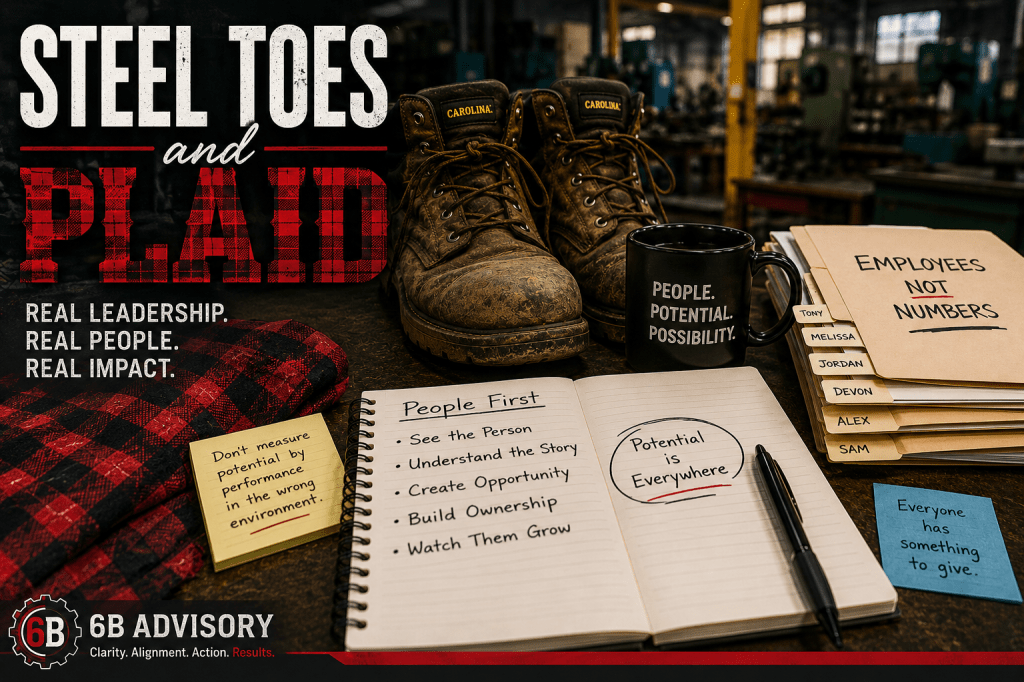
Most organizations don’t have a talent shortage. They have a visibility shortage.
I keep catching myself saying the same thing.
“When I go back to work.”
The phrase makes me laugh now.
Because if I’m being accurate, I work all the time.
I spend my days talking with people about their challenges. I connect colleagues. I make introductions. I share ideas. I trade notes. I help people think through decisions. I point opportunities in the direction of people who can make the most of them.
Then I go to bed and somehow convince myself that none of it counts as work.
Why?
Because nobody assigned it to me.
It’s not on a job description.
Nobody asked for a status update.
Nobody approved a budget.
Most importantly, nobody paid me.
For many of us, that’s the definition of work.
Work is what our employer says it is.
Work is what appears on our calendar.
Work is what generates a paycheck.
Everything else is just something we happen to be doing.
I think that’s a mistake.
Because some of the most valuable work people do is invisible.
The mentor who notices potential before anyone else.
The technician who quietly trains new hires.
The administrative assistant who keeps relationships intact.
The operator who knows exactly which machine will fail next and why.
The employee who seems to know everyone and somehow always knows who can solve a problem.
Organizations rarely measure these things.
Yet they depend on them every day.
The tragedy is that people often stop seeing their own gifts because they become too familiar.
What comes naturally gets discounted.
What feels easy gets ignored.
What creates value without creating effort gets dismissed as “just helping.”
The First Time Someone Asked
I know this pattern because I lived it.
The first time someone asked me to serve as their advisor, it changed something fundamental in how I saw myself.
They didn’t ask for coaching.
They didn’t ask for consulting.
They didn’t ask for training.
They said:
“Michelle, I need your advice.”
What they were really saying was:
“I need you to get involved.”
“I need you to tell me what you’re seeing.”
“I need you to help me navigate something I can’t see clearly from where I’m standing.”
That moment mattered more than the contract.
It mattered more than the invoice.
It mattered more than the compensation.
Someone I respected looked at a challenge they cared deeply about and decided I was the person they trusted to help them move through it.
Within forty-eight hours, the person they needed was sitting in the role.
Not the person they thought they were looking for.
The person they actually needed.
That experience taught me something important.
Most of my value was never coming from answers.
It came from seeing possibilities that other people couldn’t yet see.
The Story of Tony
The same lesson showed up years earlier in a metrology lab.
On my first day, I was told to fire a young employee.
Let’s call him Tony.
Everyone had a story about Tony.
He was late.
Constantly.
Twenty minutes late. Thirty minutes late. Sometimes more.
He showed up in sweatpants.
One morning he walked into my laboratory carrying a giant Slurpee and set it directly on top of a calibrated granite inspection table worth more than most cars.
I watched condensation drip toward a surface that cost roughly twenty-four thousand dollars.
For a moment, I understood why everyone wanted him gone.
Then I asked myself a different question.
What if they’re wrong?
Not wrong about the behavior.
Wrong about the person.
When I sat down with Tony, I discovered something interesting.
He wasn’t struggling because he lacked ability.
He was struggling because he lacked ownership.
Nobody had given him anything worth waking up for.
That felt familiar.
I know what it’s like to have talent and energy but no meaningful place to direct either one.
So instead of firing him, I gave him choices.
I showed him the challenges facing the department and asked which ones interested him.
I let him choose.
The change was almost immediate.
The young man who couldn’t arrive on time suddenly started showing up.
The employee everyone wanted to remove started taking responsibility.
The person who supposedly didn’t care began demonstrating that he cared quite a lot.
Within a few months, he was promoted.
The last I heard, he was still leading IT for that company.
Years later, I ran into his mother.
She recognized me immediately.
I didn’t recognize her at all.
She hugged me and said something I will never forget.
“We were about to kick him out.”
Not only was Tony on the verge of losing his job.
He was on the verge of losing his home.
One conversation.
One opportunity.
One leader willing to see potential instead of performance.
That was the difference.
What Leaders Miss
Which makes me wonder how many Tonys are sitting inside organizations right now.
How many people have been labeled before they’ve been understood?
How many have been measured before they’ve been developed?
How many have been confined to a role before they’ve had a chance to discover what they’re capable of becoming?
Executives often ask where the talent is.
I suspect much of it is already on the payroll.
Buried beneath routines.
Hidden by assumptions.
Constrained by systems that reward compliance more than contribution.
The answer isn’t always hiring better people.
Sometimes it’s seeing the people you already have more clearly.
The Visibility Problem
That requires disruption.
Not dramatic disruption.
Not reckless disruption.
Just enough disruption to challenge the stories we’ve been telling ourselves.
The story that this person isn’t leadership material.
The story that this employee lacks ambition.
The story that someone is only capable of the role they’re currently performing.
The story that work only counts when it’s assigned, measured, or paid for.
Human beings are far more complex than that.
Potential is far more complex than that.
And talent is often hiding in places we’ve stopped looking.
I’ve spent much of the last year saying, “When I go back to work.”
The reality is that I never stopped.
I was doing what I’ve always done.
Connecting people.
Sharing opportunities.
Helping others see around corners.
Making introductions.
Translating complexity into action.
The only thing that changed was my understanding of the value.
What came naturally felt too easy to be considered work.
What felt like a conversation was actually advisory work.
What felt like helping was actually creating outcomes.
I suspect I’m not alone.
There are people in every organization doing work that doesn’t fit neatly into a job description.
People creating value that never appears on a dashboard.
People solving problems before they become visible.
People connecting dots that nobody else sees.
The question isn’t whether they exist.
The question is whether anyone is paying attention.
Closing Reflection
Sometimes the most valuable thing a leader can do isn’t evaluate people.
It’s create enough space for them to surprise us.
Sometimes the greatest opportunity inside an organization isn’t a new hire.
It’s a fresh look at the people already standing in front of us.
And sometimes the work that changes lives isn’t the work we count.
It’s the work we almost overlook.
 Slingshot Designs