

Learning to See What Was Already There

This morning I watched the garbage truck make its way down our street.
The truck itself was impressive.
The driver guided the vehicle alongside each can while a mechanical arm reached out, grabbed it, lifted it, emptied it, and returned it almost exactly where it started.
The motion was smooth.
Consistent.
Accurate.
Almost elegant.
Then the truck reached the end of the street and began backing out.
And my brain did what it has done for as long as I can remember.
I stopped seeing a garbage truck.
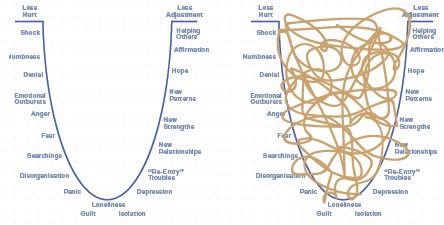
I started seeing a spaghetti diagram.
Not the clean version from a textbook.
The real version.
The one where actual movement rarely follows the neat lines we draw on paper.
As the truck backed out of the street, I could almost see the marker moving across a page.
Forward.
Stop.
Reverse.
Forward.
Stop.
Reverse.
A route appearing one movement at a time.
By the time the truck reached the entrance to the neighborhood, I wasn’t really watching a vehicle anymore.
I was watching a pattern.
The truck exited.
A while later, a second truck arrived to collect recycling and repeated much of the same route.
The spaghetti diagram grew.
Additional lines.
Additional motion.
Additional transportation.
Additional fuel.
Additional decisions.
Not necessarily wrong.
Just visible.
And visibility has always interested me more than certainty.
That observation stayed with me because earlier that morning I had been reviewing Brian DeVries’ manuscript for the next edition of Kata in the Kingdom.
Before that, I had been listening to Jeffrey Liker discuss revisions to The Toyota Way and the influence of Mike Rother’s work on Kata.
Different people.
Different paths.
Different contributions.
Yet all circling the same idea.
Learn to see.
Not just what is happening.
What might be happening.
What assumptions are hiding beneath what appears obvious.
What possibilities exist beyond the edge of current understanding.
That idea resonates deeply with me because I encountered versions of it long before I had language for it.
When I worked at Guardian Industries, I found myself surrounded by people who understood systems in a way I would spend years trying to articulate.
Procurement wasn’t separate from manufacturing.
Manufacturing wasn’t separate from quality.
Quality wasn’t separate from community.
Community wasn’t separate from culture.
Everything touched everything.
One of the projects I became known for involved expanding and formalizing a recycling program.
What began as a relatively simple effort evolved into a broader trash-to-cash initiative involving paper, cardboard, Styrofoam, distribution centers, and electronics collection events for employees and their families.
The more I worked on it, the less it looked like a recycling program.
It looked like a system.
A living one.
Five hundred employees meant five hundred families.
Five hundred families meant a community.
The waste stream connected to purchasing.
Purchasing connected to production.
Production connected to logistics.
Logistics connected to customers.
Everything touched everything.
Looking back, I don’t think Guardian taught me observation.
It gave me permission to trust it.
I was fortunate to spend my early career around leaders who treated curiosity as an asset rather than a distraction.
By the time I encountered Lean, Kata, scientific thinking, VoicePrint, coaching models, and systems thinking, I wasn’t learning how to observe.
I was learning how to communicate what I had already seen.
Years ago, when I was substitute teaching, one of my favorite classroom rewards was a short lesson explaining pressure patterns in tempered glass.
Students would watch in amazement as invisible stresses became visible.
The break pattern revealed what had been there all along.
Looking back, I suspect that lesson stayed with me because it explained something I had already observed in organizations, families, communities, and people.
The pattern is usually present before the fracture.
That may be why I continue to find the same patterns everywhere.
In manufacturing.
In families.
In communities.
In bird migrations.
In gardens.
In healthcare.
In education.
In VoicePrint.
In the behavior of ants.
And apparently, in garbage trucks.
Beyond the Fog
The more I study different disciplines, the less interested I become in defending any particular framework and the more interested I become in the thread connecting them.
Observation.
Curiosity.
Experimentation.
Learning.
Adaptation.
The willingness to move one step beyond the fog even when the entire path is not yet visible.
Perhaps that is why communities like Kata in the Classroom and Kata in the Kingdom feel so familiar to me.
Not because they are teaching something entirely new.
Because they are helping people recognize, trust, and strengthen capabilities they may already possess.
Observation.
Experimentation.
Self-leadership.
The ability to orient before moving.
The ability to learn while moving.
The ability to continue moving when certainty is unavailable.
The settings change.
The principles do not.
The birds don’t know they’re teaching migration theory.
The ants don’t know they’re demonstrating logistics.
The garbage truck driver isn’t thinking about spaghetti diagrams.
Yet the patterns are there for anyone willing to look.
The difference has never been intelligence.
The difference is observation.
 Slingshot Designs