
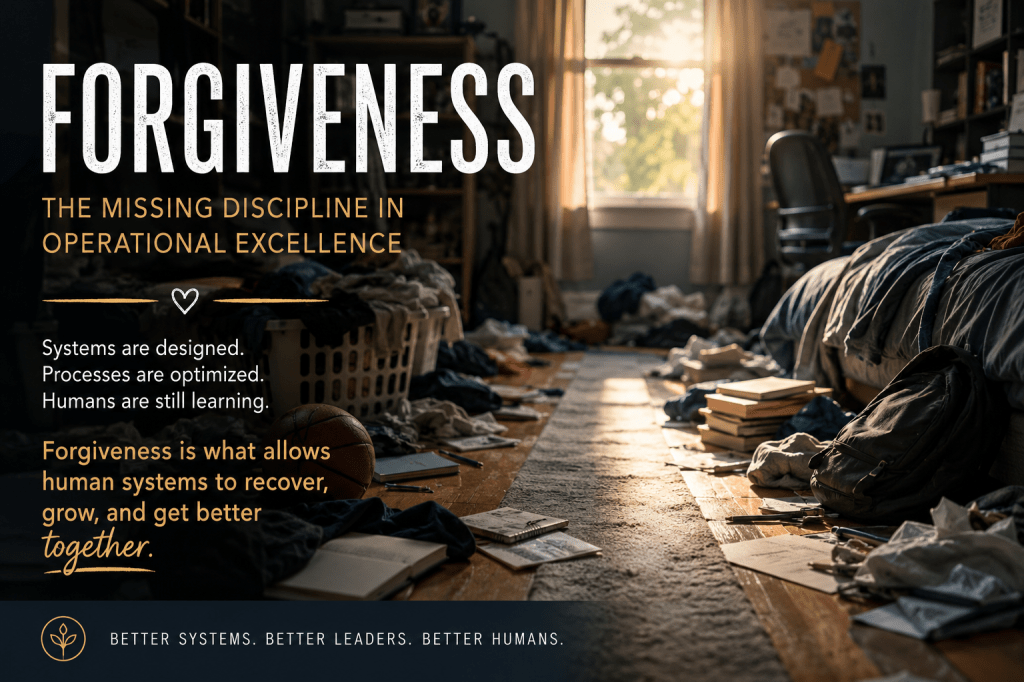
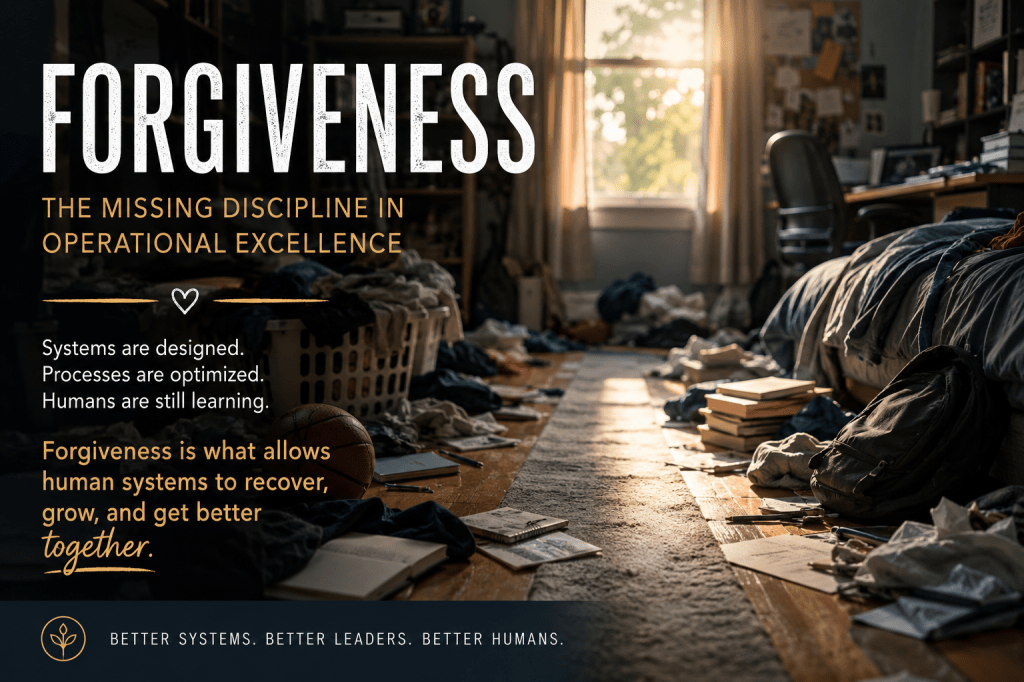
A narrow path cuts through the clutter as evening light fills the room — a reminder that operational excellence is not built by eliminating human failure, but by learning how to recover, repair, and grow together.
“Earth is forgiveness school.” — Anne Lamott
There comes a point in most lives when we are well served to step off the treadmill long enough to take a real inventory.
What value are we generating?
Who does it actually serve?
And how is our environment structured to support — or sabotage — the way we operate?
Operational excellence is not limited to factories, hospitals, or boardrooms. It exists in homes, families, classrooms, and communities. Any place where human beings interact repeatedly under pressure develops systems, whether intentionally designed or not.
And every system leaves a trace.
The Human System
Human beings are a fascinating species.
Children and young adults are often easier to teach because their minds remain flexible enough to hold competing ideas at the same time. They can evaluate contradiction without immediately rejecting it. Their thinking has not yet calcified around identity protection or institutional habit.
Adults, on the other hand, are frequently better at systematizing outcomes. We build routines. We create repeatable processes. We learn to optimize.
But adults also accumulate something else: operational drag.
In Lean and Six Sigma, there are three concepts used to identify systemic dysfunction:
- Muda — waste
- Muri — overburden
- Mura — unevenness
These “3 M’s” are signals. They help us identify where friction exists inside a system.
A Lean thinker studies process flow with a simple question in mind:
If I do this, what does the system do in return?
For example, if you submit a contact form on a company website, that action may trigger an entire chain of automated behaviors:
- a sales representative contacts you within a predefined window,
- your information enters a marketing database,
- and newsletters, reminders, and promotions begin arriving in carefully timed intervals designed to increase engagement.
The process is deliberate. Optimized. Measured.
Too much communication and the customer feels manipulated.
Too little communication and the customer disappears.
Every system is balancing pressure, timing, cost, and perceived value.
What Systems Are Actually Designed to Do
Increasingly, system literacy is revealing an uncomfortable reality:
Many organizations are no longer optimizing primarily for customer independence. They are optimizing for efficiency, shareholder protection, automation, scalability, and reduced operational exposure.
The burden quietly shifts toward the consumer.
The customer does more work while receiving less value.
Self-checkout lanes become unpaid labor.
Customer service becomes a chatbot maze.
Digital systems route people away from humans while asking users to resolve increasingly complex problems themselves.
This raises an important question:
Who are these systems actually serving?
Sometimes the answer is the customer.
Sometimes it is the worker.
Sometimes it is the community.
But increasingly, the answer is the shareholder.
And once you see that pattern clearly, it becomes difficult to unsee.
Mapping the Terrain
Value stream mapping gives organizations a topographical survey of how work moves through a system. It reveals delays, redundancies, bottlenecks, handoff failures, and waste accumulation.
That matters.
But understanding the terrain is not the same thing as understanding how to lead people through it.
Operational excellence requires more than metrics. It requires observing human behavior under real conditions.
Lean and Six Sigma practitioners study whether time, energy, materials, and attention are being invested wisely from the perspective of stakeholders. We follow value from inception to delivery and examine what happens when systems break down.
One thing becomes immediately apparent during this work:
We do not particularly enjoy the prefix “re–”.
- Rework
- Retraining
- Redesign
- Recalibration
Each one represents something that was not done correctly the first time.
And yet, no matter how sophisticated the system becomes, humans remain human.
Which means error remains inevitable.
This is where forgiveness enters the conversation.
Forgiveness Inside the System
Forgiveness is often misunderstood as softness, avoidance, or surrender.
It is not.
Forgiveness is what allows a system to remain functional while humans continue learning inside it.
As a leader, sitting inside a mess you helped create can feel maddening.
It is like sitting on the edge of your teenager’s bed while surveying weeks of accumulated disorder:
- unprocessed laundry,
- candy wrappers,
- unfinished projects,
- forgotten responsibilities,
- treasured objects buried beneath piles of work-in-progress.
You have had this conversation before. Maybe many times before.
At some point frustration naturally emerges:
When are they finally going to learn?
This is the moment where leadership either becomes punishment or stewardship.
This is where forgiveness takes the lead.
What Forgiveness Actually Means
Forgiveness does not mean forgetting.
It does not mean lowering standards or pretending harm did not occur.
Real forgiveness says:
I still see your capability clearly, even while confronting your failure honestly.
It recognizes that human beings learn unevenly.
It accepts that growth is rarely linear.
It allows room for development without abandoning accountability.
Forgiveness is not the absence of standards.
It is the refusal to weaponize standards against people who are still learning.
That distinction matters.
Because systems without accountability collapse into chaos.
But systems without forgiveness collapse into fear.
Neither produces excellence.
The highest-performing environments are not the ones without mistakes. They are the ones capable of recovering from mistakes without destroying the humans inside the process.
That requires wisdom.
That requires restraint.
That requires grace.
Excellence is not built by eliminating human failure.
It is built by learning how to carry one another through it without abandoning the standard.
 Slingshot Designs