
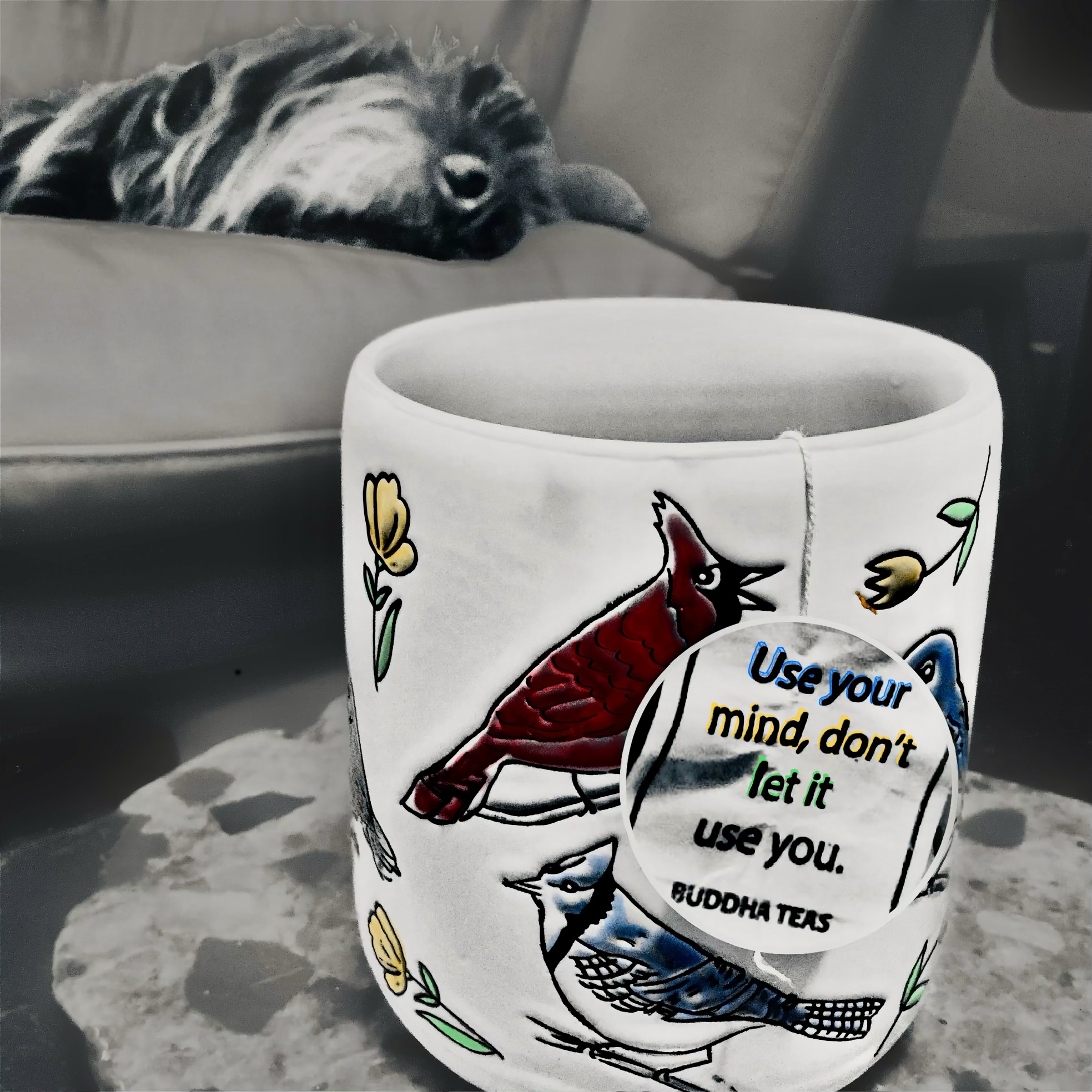
A quiet winter moment: tea steeping, a cardinal mug, and a resting dog — reminders that safety, presence, and clear thinking are the foundations of humane leadership.
A Mug, A Dog, and a Sentence About the Mind: Civilization, Distilled
There is a particular kind of clarity that arrives in ordinary moments. Not during conferences or strategy sessions, but in the quiet geometry of a kitchen counter: a mug, a sleeping dog, a sentence that reads, Use your mind, don’t let it use you.
Civilization, distilled.
The tools have changed. The stakes have not.
The Portable Studio Era
The shift to a fully integrated iOS workflow has transformed creative cadence. Inspiration at mid-morning can become a published artifact by lunchtime. Capture, edit, write, design, and distribute — all within a single ecosystem that reduces friction between thought and expression.
This is not convenience for its own sake.
It is velocity in service of meaning.
When the distance between insight and publication collapses, ideas no longer decay in notebooks or drafts. They enter the world while still alive.
Entrepreneurial work thrives in this environment because it rewards responsiveness. The system is always in motion; the creator must be able to meet it there.
Continuous Improvement as Art and Science
Learning and development are not programs. They are conditions.
Continuous improvement is often framed as industrial discipline — metrics, cycles, controls. That framing is incomplete. Improvement is also aesthetic judgment, pattern recognition, and the courage to revise one’s own assumptions.
It is both art and science because it requires:
Measurement without dehumanization Creativity without chaos Structure without rigidity Adaptation without drift
The simplest truths endure because they work across contexts. Observe. Adjust. Repeat.
The Dog as a Safety Instrument
Dogs are excellent judges of environment. They do not read mission statements. They read nervous systems.
A dog that settles is a signal: safety, predictability, trust.
A dog that paces or startles is a signal: something is wrong.
Dylan does not negotiate with pretense. If the environment is unsafe, he will make it known. That clarity is instructive. Humans often override their own signals in service of performance, hierarchy, or fear of disapproval.
Safety is not a soft concern. It is operational infrastructure.
Psychological safety determines whether people speak up, report defects, admit uncertainty, and prevent harm. Without it, systems fail silently until they fail catastrophically.
Management Is Not Ownership
There was a time when leaving during lunch to let the dog out was treated as a breach of commitment — even during audits and customer visits. The implied expectation was that professional legitimacy required neglecting personal responsibility.
The suggestion to “get rid of the dog” revealed a deeper confusion: authority mistaken for ownership of another person’s life.
Management coordinates work.
Ownership implies control over the person.
The distinction matters.
Organizations that demand the erosion of basic decency in the name of productivity are not optimizing performance. They are externalizing their inefficiencies onto human lives.
Leadership Worth Remembering
Not all leadership experiences become stories worth telling. Some become boundary lines.
There are leaders who earn admiration through integrity, clarity, and care. Their names are spoken with gratitude. Their practices are replicated.
There are others who chisel themselves onto the Naughty List through neglect, coercion, or indifference. Their lessons are preserved as warnings rather than tributes.
Both contribute to development. One through example. The other through refusal.
Refusal as a Strategic Act
After surviving a year defined by compounded hardship, a decision emerged with unusual clarity: refuse the predictable repetition of harm.
Refusal is not withdrawal. It is redirection.
When institutional environments cannot support humane practice, the work does not end. It relocates. Donating elite services to local communities is not charity as consolation; it is a reallocation of expertise to systems capable of using it responsibly.
The opportunity did not appear until survival made it non-negotiable.
Why These Days Matter
A portable studio.
A sleeping dog.
A sentence about the mind.
Work that aligns with conscience.
These are not small victories. They are structural shifts toward agency.
The days when inspiration becomes publication within hours are worth remembering because they demonstrate a restored feedback loop between thought and action. They prove that the distance between who we are and what we do can, with effort and courage, be reduced.
Civilization is not built in grand gestures. It is built in kitchens, in quiet refusals, in systems redesigned to hold human dignity as a non-negotiable constraint.
Ask the dog. He knows.