
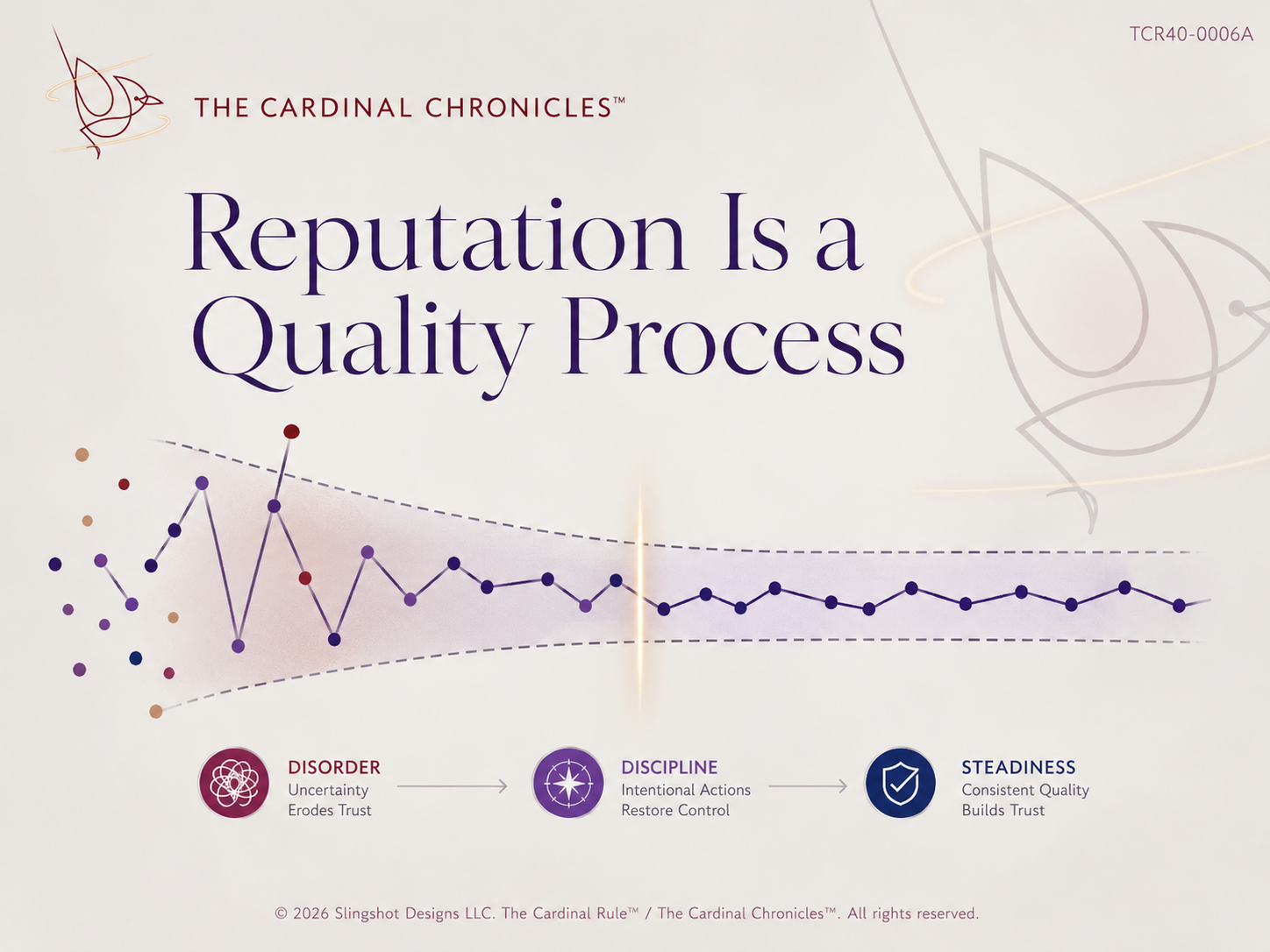
When reputation is damaged, the first instinct is often to explain harder.
More context. More detail. More evidence. More words.
Sometimes explanation is necessary. Sometimes silence creates more confusion. But there is a limit to what explanation can repair.
You do not argue a process back into control. You demonstrate control.
Reputation behaves like accumulated process evidence.
A reputation is not one statement. It is a pattern of observations collected by other people over time.
That is why a serious breach can feel so expensive. The event itself may be short. The recovery period is not.
If a process suddenly produces a catastrophic defect, we do not restore confidence by insisting the process is actually excellent. We contain the problem, understand what failed, correct the condition, demonstrate stable performance, and verify that the correction holds.

The Board disagrees about what to do first.
Dove is concerned with trust and harm. Who no longer feels safe? Who needs enough information to understand what changed? What repair matters because people—not metrics—carried the consequence?
Owl identifies the failure. What specifically broke? What is verified? Which corrective action addresses the actual failure rather than the most embarrassing symptom?
Peacock wants to communicate. That is not wrong. Reputation is social. People need signals. But Peacock can easily confuse communication with correction and draft nine pages before the process has changed.
Eagle looks across time. What has restored trust in this system before? What pattern would observers need to see repeatedly before confidence reasonably changes? Where could the same failure recur if we only fix the visible event?

Cardinal integrates both truths:
Explain enough to orient people. Then let the changed process become the argument.
Time is part of the corrective action.
Some damage cannot be repaired instantly because the evidence required to repair it does not exist yet.
If trust was damaged by inconsistency, consistency has to become observable. If the failure involved secrecy, transparency has to become ordinary. If the failure involved poor judgment, better judgment has to appear repeatedly enough that people stop treating it as an exception.
That is not punishment. It is verification.
Field Work: build a recovery control plan.
The Reputation Recovery System below is available to free Slingshot members.

Choose one trust or reputation issue and move it through the sequence:
- Breach: What failed?
- Contain: What must stop or be protected now?
- Understand: What does the evidence say?
- Correct: What changes the underlying condition?
- Demonstrate: What would changed performance look like?
- Verify: What would tell us it held?
Then ask one uncomfortable but useful question: What am I tempted to explain that would be better demonstrated?