

One of the greatest misconceptions we carry into adulthood is the belief that age and maturity arrive together.
They don’t.
Time passes automatically.
Growth does not.
Over the past few years, I’ve had the opportunity to watch groups of teenagers navigate friendships, misunderstandings, loyalty, exclusion, reconciliation, and conflict. Sometimes they handled those moments beautifully. Sometimes they didn’t. That’s expected. They’re learning.
What surprised me wasn’t the teenagers.
It was recognizing some of the very same patterns among adults.
Adults whose brains have long since finished developing.
Adults with decades more experience.
Adults raising children while sometimes responding with the same emotional strategies their children are still trying to outgrow.
That realization forced me to ask a different question.
What if emotional maturity isn’t something we achieve?
What if it’s something we intentionally practice?
Throughout my career—in manufacturing, quality management, leadership, organizational excellence, compliance, safety, and complex problem solving—I learned that systems improve only when people are willing to examine themselves honestly. The same principle applies to families, friendships, and communities.
High-performing teams don’t become exceptional because they avoid mistakes.
They become exceptional because they know how to learn from them.
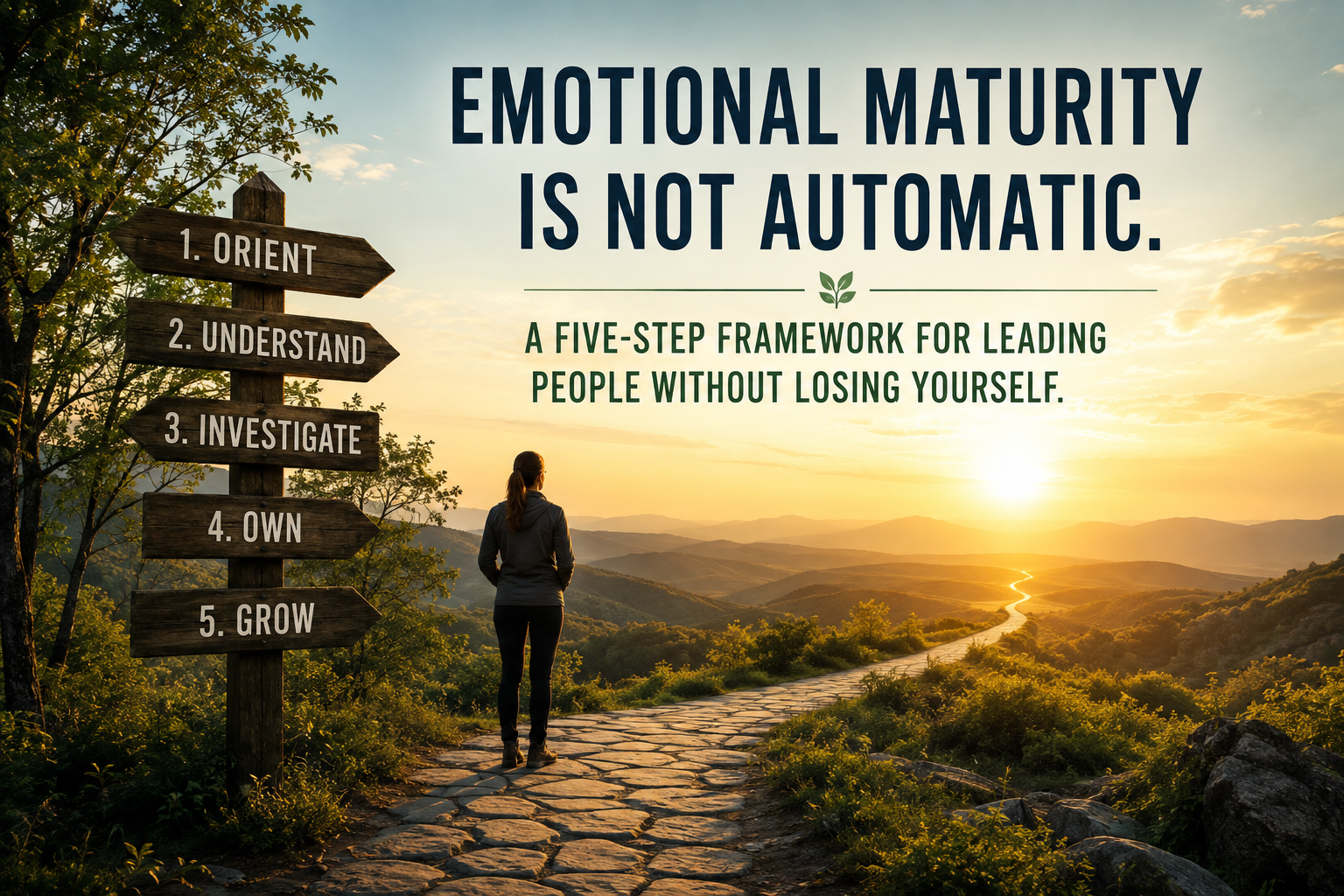
Over time, I developed a simple five-step framework that has become one of the ways I evaluate any human system, whether it’s a workplace, a family, a volunteer organization, or my own relationships.
Step One: Orient Before You Lead
Before asking anyone else to move, understand where they actually want to go.
Too many leaders begin with direction instead of orientation.
Parents do it.
Managers do it.
Community leaders do it.
Even well-intentioned friends do it.
But people rarely resist leadership itself.
They resist being driven toward destinations they never helped define.
Ask better questions.
What matters to them?
What are they trying to build?
What are they afraid of losing?
What does success actually look like through their eyes?
If you don’t know the answers to those questions, you aren’t leading people.
You’re steering assumptions.
Step Two: Know the System You’re Working With
Every team has strengths.
Every team has blind spots.
Every family carries patterns.
Every organization develops habits.
The healthiest systems don’t pretend those realities don’t exist.
They study them.
Who naturally brings calm during conflict?
Who withdraws?
Who needs more information before acting?
Who seeks connection first?
Who values certainty?
Who needs autonomy?
Understanding the people inside a system isn’t manipulation.
It’s respect.
You cannot effectively lead what you refuse to understand.
Step Three: Investigate Patterns, Not Moments
One difficult conversation tells you very little.
Repeated patterns tell you almost everything.
This is one of the most important lessons quality management ever taught me.
Don’t investigate the loudest symptom.
Investigate the recurring conditions that allow it to happen.
The same is true in relationships.
Ask:
Is this unusual?
Or is this predictable?
One mistake deserves grace.
A repeating pattern deserves investigation.
The goal isn’t blame.
The goal is clarity.
Step Four: Own Your Portion Completely
Every healthy system depends on one habit.
Personal accountability.
Not performative accountability.
Real accountability.
The willingness to ask:
“What part of this belongs to me?”
That question changes families.
It changes marriages.
It changes workplaces.
It changes communities.
Children learn this by watching adults.
If adults never model accountability, children learn defensiveness instead.
The strongest leaders I have ever known were never the people who avoided mistakes.
They were the people who repaired them.
Step Five: Choose Growth Before Comfort
This is where change becomes visible.
Every unresolved emotional pattern eventually comes due.
Avoided conversations.
Unexamined beliefs.
Old resentments.
Inherited habits.
They don’t disappear simply because time passes.
They accumulate.
Eventually, life presents a situation that demands skills we postponed developing years—or decades—earlier.
That is the cost of delayed growth.
The encouraging news is that growth remains available.
At any age.
Every difficult conversation becomes practice.
Every apology becomes practice.
Every repaired relationship becomes practice.
Every moment of honest reflection strengthens the next generation far more than pretending we’ve already arrived.
The Teams That Last
Whether I’m working with executives, manufacturing teams, community organizations, or families, I keep returning to the same conclusion.
The healthiest systems aren’t made up of perfect people.
They’re made up of people who are willing to become increasingly self-aware together.
They know each other’s strengths.
They acknowledge each other’s limitations.
They adapt.
They repair.
They learn.
Most importantly, they understand that respect isn’t simply treating people kindly.
Respect begins by recognizing that every person deserves agency over their own destination.
Leadership isn’t pulling people where we think they should go.
It’s helping them move intentionally toward where they are capable of becoming.
Emotional maturity isn’t automatic.
It’s a decision we make repeatedly, one conversation, one act of accountability, and one repaired relationship at a time.