
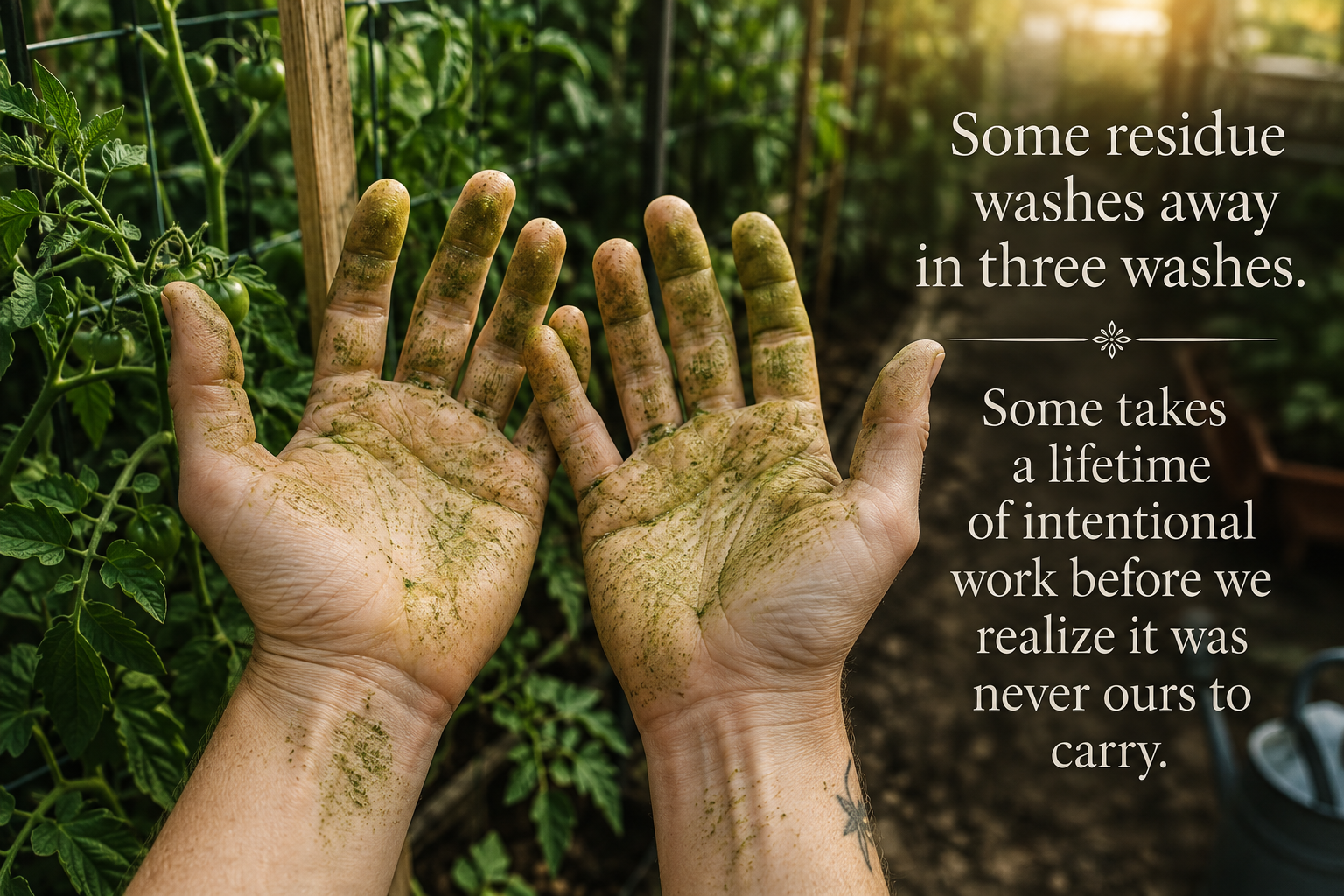
Yesterday I spent hours in the garden training tomato vines.

Not pruning them.
Not harvesting them.
Simply guiding them.
Untangling weeks of growth so each vine had room to become what it was already trying to become.
When I finally came inside, I washed my hands.
The water turned an almost neon lime green.
I washed them again.
Still green.
A third time.
Only then did most of it disappear.
The pollen had worked its way into every crease of my hands, halfway up my arms, and under my fingernails. It wasn’t dangerous.
Just incredibly sticky.
It made me think about something I’ve been wrestling with for years.
Not pollen.
Residue.
This morning I came across a quote that said the cruel voices in our heads are often echoes of how we’ve been treated.
I think that’s partly true.
But I don’t think they’re just echoes.
I think they’re residue.
Echoes disappear.
Residue stays until you intentionally clean it off.
That’s an important distinction.
Because so many of us spend years believing those thoughts are simply who we are.
“I’m too much.”
“I’m too sensitive.”
“I always screw things up.”
“I’m hard to love.”
“I’m behind.”
“I’m not enough.”
Maybe.
But before you accept those thoughts as truth, it’s worth asking another question.
Who first left that residue behind?
One of the greatest lies I ever believed was that everyone experienced me the same way.
They don’t.
No one does.
The person standing in front of me has never stood inside of me.
They have never watched the thousands of decisions I’ve made when no one was looking.
They haven’t lived inside my intentions.
Neither have I lived inside theirs.
That isn’t unique to me.
It’s true for every human being alive.
Which means every opinion someone forms about us is incomplete by definition.
Some are incredibly insightful.
Some are wildly inaccurate.
Some were accurate twenty years ago and expired long ago.
Yet we carry all of them as though they’re permanent labels.
As I’ve gotten older, I’ve stopped asking only, “Who am I?”
I’ve started asking something different.
Who has been leaving residue on me?
When I look back over my life, patterns emerge.
Certain people consistently left me feeling more capable than when they found me.
Others consistently left me questioning my own reality.
Some celebrated my growth.
Some tolerated it.
Some benefited from my self-doubt.
Those patterns matter.
Not because they’re evidence that someone is good or bad.
Because patterns tell the truth that isolated moments often hide.
I sometimes imagine my life as a little neighborhood store.
Not because people can own me.
They can’t.
But because watching how people “shop” tells me something.
Some people come in to contribute.
They invest.
They build.
They leave the place better than they found it.
Some browse respectfully.
They’re kind.
They don’t need access to every shelf.
They’re perfectly happy knowing me from where they stand.
Most people belong here.
Then there are people who don’t come to contribute at all.
They come to consume.
To take.
To criticize.
To leave fingerprints on everything without adding value in return.
When you begin paying attention to people’s shopping habits instead of their marketing slogans, something interesting happens.
Their actions become much easier to understand.
People tell us who they are all the time.
Not primarily with words.
With patterns.
For a long time I thought healing meant convincing everyone to see me accurately.
I don’t think that anymore.
Now I think healing is deciding who gets access to the store in the first place.
Not everyone belongs in the stockroom.
Not everyone needs the keys.
Not everyone earns a place in your private spaces.
And that isn’t punishment.
It’s stewardship.
I also don’t think healing means pretending residue doesn’t exist.
It does.
Some of mine accumulated over decades.
Some of it still catches me off guard.
There are still moments when I hear a harsh thought and have to stop long enough to ask,
“Is that actually my voice?”
Sometimes it is.
Sometimes it’s remarkably old.
The difference today is that I know to ask.
That’s growth.
Not perfection.
People often ask why I’m such an advocate for therapy.
It isn’t because I think therapy fixes people.
People aren’t broken machines.
A good therapist doesn’t hand you a new identity.
They help you notice what you’ve been carrying that was never yours to begin with.
The best sessions I’ve ever had didn’t end with me feeling validated.
They ended with me seeing myself—and my past—with just enough additional clarity that the present made more sense.
That’s what perspective does.
It loosens the residue.
It doesn’t always remove it in one wash.
Sometimes it’s the first of three.
Sometimes it’s the twentieth.
Healing is less like flipping a switch than washing tomato pollen off your skin.
Slowly.
Patiently.
Repeatedly.
Over the years I’ve made one conscious decision that has shaped almost everything I do.
I want the residue I leave on other people to make them stronger.
Not dependent on me.
Not impressed by me.
Not indebted to me.
Stronger.
I want people to leave conversations believing a little more in themselves than when they arrived.
Do I get that right every day?
Of course not.
None of us do.
Leadership, friendship, marriage, parenting—none of these are perfect performances.
They’re continuous improvement.
Every one of us leaves something behind in the people we meet.
The question isn’t whether we leave residue.
We all do.
The question is whether what we leave becomes nourishment…
or something another human being has to spend years trying to scrub away.
Yesterday, it took me three washes to remove tomato pollen from my skin.
Some residue takes decades.
The encouraging part is this:
Just because something has been stuck to you for a long time doesn’t mean it belongs to you.
And maybe that’s where healing begins.
Not by asking, “What’s wrong with me?”
But by asking,
“What am I still carrying that was never mine to keep?”