
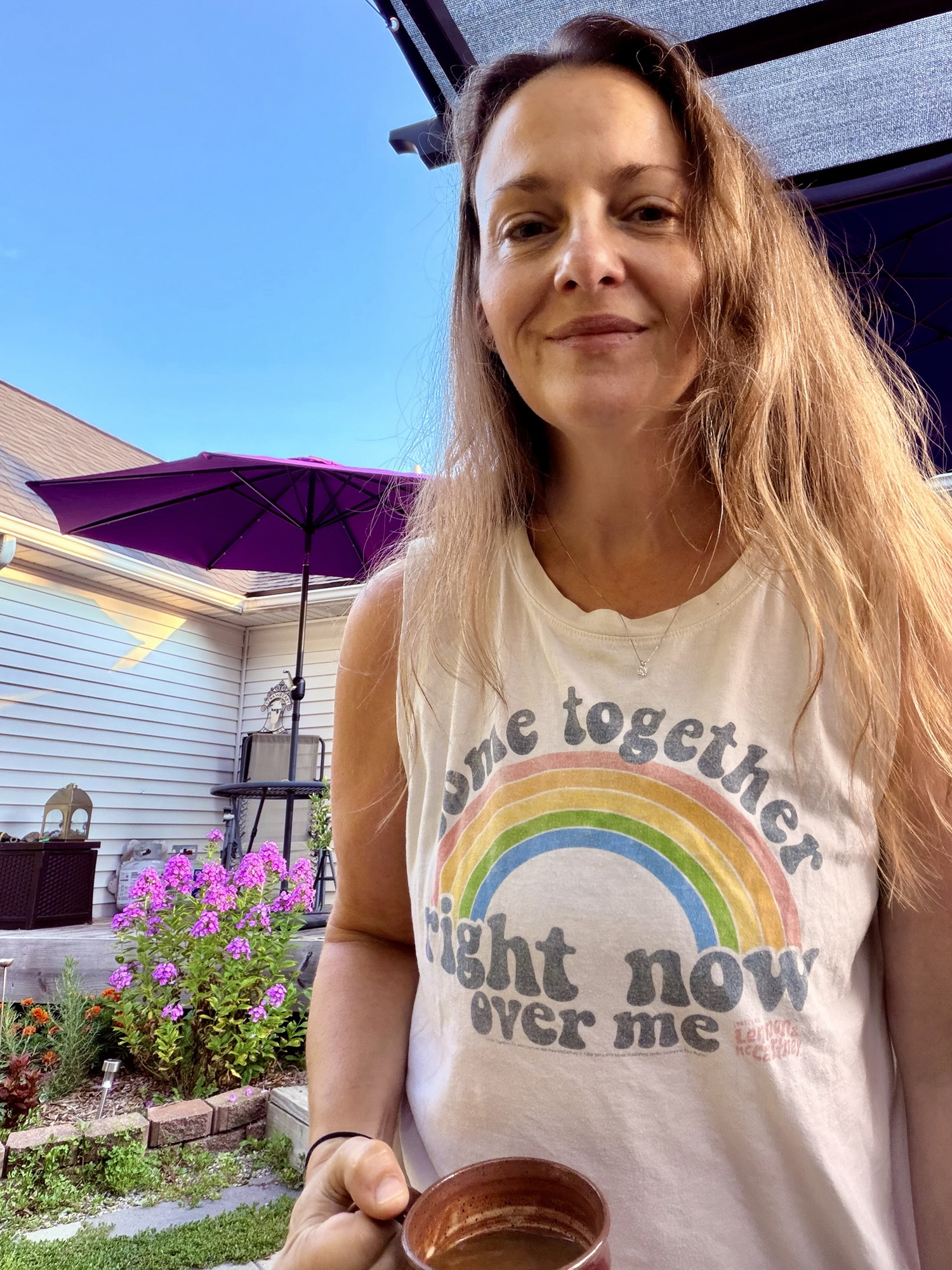
Good morning! ☀️

May today be filled with grace, joy, and abundant love.
If you’re thriving, share the stories that helped you learn how. Pay the knowledge forward. Someone else is standing where you once stood.
Throughout my life, I’ve collected far more seeds for the garden in my mind than I ever have for the gardens around my home.
I’m often asked for gardening advice, which always makes me think back to my first outdoor garden of my own… sort of.
I was renting a duplex in Ferndale, and my landlord let me convert an overgrown sandbox into a garden.
I was elated.
I ran outside, ripped the weeds off the surface, dug a few holes, and dropped in a bunch of seeds.
I laugh at that younger version of myself often.
What a rookie.
And what a garden it became.

Today, Dylan, a cup of coffee, and I begin most mornings walking our little urban homestead-in-the-making. I check on a few dozen plants, shrubs, trees, and projects. I know the names of nearly everything growing here—whether it’s something we’re intentionally cultivating or something we’re carefully managing.
Over the years, I’ve learned that gardening isn’t really about growing plants.
It’s about learning to see.
When something unexpected appears, I don’t automatically pull it anymore.
Not because every volunteer belongs there.
But because I don’t yet know what it is.
Some of my favorite plants first showed up looking exactly like weeds.
So I watch.
I learn.
I give it a little time.
Eventually it reveals itself.
If it’s something beneficial, I make room for it.
If it’s something that doesn’t belong, I remove it—but usually not the instant I recognize it.
Ironically, it’s often easier to pull after it’s grown a bit. The stem is stronger, the roots haven’t completely taken over, and I can remove it cleanly without disturbing everything around it.
Then comes the part that matters most.
I don’t leave bare ground.
Nature dislikes a vacuum.
If I simply pull the weed and walk away, something else will eventually fill that space.
So I scatter wildflower seed.
Not because I intend for wildflowers to live there forever, but because I’d rather the space be occupied by something beneficial while I decide what belongs there long-term.
Months later, when I’m finally ready to plant intentionally, those wildflowers have done their job. They’ve protected the soil, supported pollinators, improved the ecosystem, and because they never became permanently established, they’re easy to remove. They leave the ground healthier than they found it.
The more time I spend in the garden, the harder it becomes to ignore how often people work the same way.
Whether I’m thinking about my family, friends, colleagues, clients, neighbors, complete strangers—or even Dylan standing patiently beside me with his own morning routine—I find myself returning to the same lesson.
Growth doesn’t respond well to force.
Discernment almost always outperforms assumption.
Healthy boundaries aren’t about ripping everything out at the first sign of discomfort. They’re about learning what you’re looking at before deciding what belongs, what needs tending, what needs pruning, and what needs to go.
And when we finally remove something that no longer serves us—a habit, a belief, a relationship, a fear—we’re wise to replace it with something intentional.
Otherwise, the empty space rarely stays empty for long.
Maybe that’s why I love gardening so much.
It isn’t because I grow vegetables.
It’s because every season reminds me that stewardship is less about control and more about paying close attention.
And I’ve yet to meet a garden—or a person—that didn’t flourish when given enough patience, curiosity, and care.
Have a beautiful day. 🌱☕🐾
One response to “The Garden in My Mind”
One of the hardest lessons for me has been realizing that not every unexpected thing is a problem to solve. Sometimes it needs observation before action. I’m curious—what has nature taught you that you’ve carried into the rest of your life? 🌱