
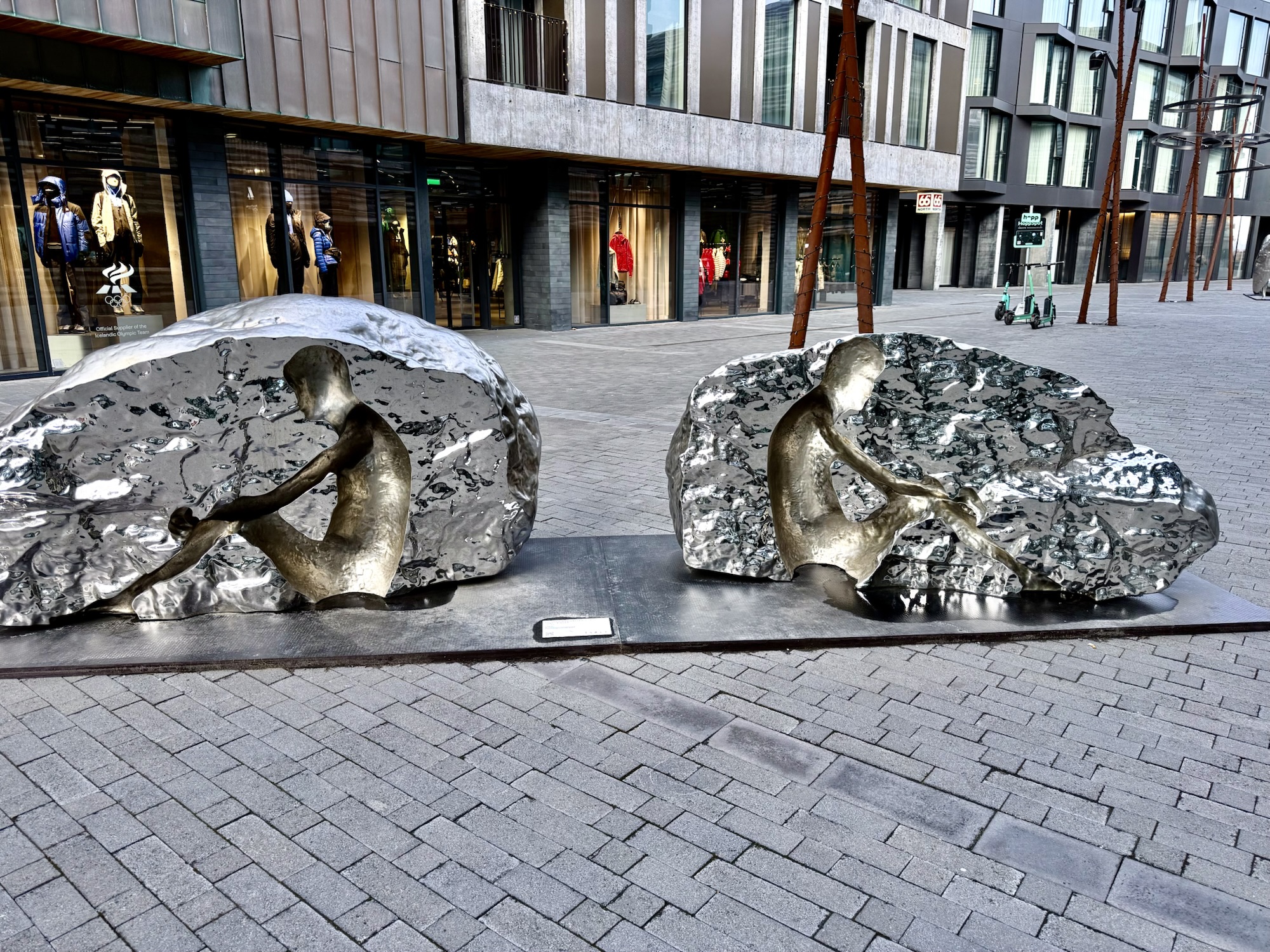

“Roots” — Reykjavík, Iceland.
Sculpture by Steinunn Þórarinsdóttir.
I saw a post recently from someone I admire. The post listed things they were giving up: engagement surveys, unknown calls, signing up for mailing lists, endless requests for ratings and reviews. Small things on the surface. Ordinary things. But together they formed a pattern I recognized immediately.
Withdrawal.
Not from life itself, but from systems that no longer feel trustworthy.
As someone who has spent years working in learning, development, and organizational systems, that gave me pause. Engagement surveys, for example, are supposed to represent the voice of the customer. In theory, they help organizations adapt, improve, and serve people better. But somewhere along the way, many systems stopped feeling reciprocal. People began to feel mined instead of heard.
That distinction matters.
You can feel the shift happening across industries and communities right now. People are pulling back their data, their energy, their participation, their availability. They are becoming more protective of their privacy, their attention, and their peace. Not because they are antisocial, but because the cumulative weight of exposure has become exhausting.
I understand that instinct intimately.
This past year, I found myself rebuilding my own systems almost from the ground up after multiple security breaches and privacy concerns forced me to reevaluate everything. I transitioned my personal technology ecosystem, changed workflows, unsubscribed from countless platforms, tightened boundaries, and reconsidered what deserved access to my time and information.
None of that is simple under normal circumstances. It becomes far more complicated when layered on top of family responsibilities, professional obligations, caregiving, and the emotional labor of simply trying to remain functional in a world that increasingly demands constant access to the self.
People often underestimate how much unpaid labor modern vigilance requires.
The more interconnected your life becomes, the more vulnerable it becomes. Families, entrepreneurs, artists, caregivers, and people with intellectual property or specialized expertise all carry forms of exposure that are difficult to explain until something goes wrong. Once it does, you realize how much of your life exists in systems you do not fully control.
That realization changes people.
For me, it changed the way I think about pressure.
In February, my husband and I traveled to Iceland. We went not simply as tourists, but as observers. I was studying pressure at the time — specifically how pressure moves through systems, relationships, and families. Iceland felt like the right place to study that question. A land shaped by fire, ice, tectonic movement, and survival.
While we were there, I received my first tattoo at forty-eight years old: a Nordic stave chosen as a marker of endurance, orientation, and intentional living under complexity. Unlike most versions, the center of mine is not empty. It contains a natural landscape because nature has always been my reference point. Nature tells the truth about pressure.
Pressure ignored becomes rupture.
Pressure trapped becomes instability.
Pressure redirected can become transformation.
That principle applies to geology, ecosystems, organizations, families, and individual human beings alike.
Too often, people try to discharge pressure outward instead of metabolizing it inward. We project it onto coworkers, spouses, children, institutions, or strangers online. We defend our discomfort rather than examine it. We protect our patterns instead of adapting them.
But pressure has to go somewhere.
If it does not move toward behavioral change, it usually moves toward collateral damage.
That realization has changed how I think about boundaries as well. There comes a point in life when understanding someone’s pain does not obligate you to remain inside the blast radius of their behavior. Compassion without boundaries becomes self-erasure. Insight without action becomes stagnation.
Some people understand others so deeply that they become vulnerable to absorbing damage that was never theirs to carry.
I know that dynamic well.
People who think deeply and perceive patterns quickly are often misunderstood. Others assume you see darkness in them when, in reality, you simply recognize how much darkness they have survived. There is a difference. One is judgment. The other is recognition.
Still, recognition alone cannot sustain healthy relationships, healthy systems, or healthy communities. At some point, adaptation must become material. Observable. Sustained over time.
There cannot be endless backsliding.
This became especially clear to me recently while navigating healthcare decisions of my own. After years of distrusting certain systems, I made a conscious decision to reengage locally rather than seeking distance or escape. I wanted to practice what I often tell others: bloom where you are planted.
That choice immediately forced me to confront one of the hardest truths about institutions: bias is unavoidable. Every professional carries personal experiences, assumptions, and contextual lenses into their work. The question is not whether bias exists. The question is whether people are disciplined enough to remain curious in the presence of it.
I do not want healthcare providers who pretend they are emotionless machines. I want providers capable of recognizing their assumptions while still investigating the individual standing in front of them. There is a profound difference between personalizing care and categorizing people.
One requires attention.
The other requires convenience.
Scientific thinking demands humility. It requires the ability to compare, contrast, revise, and reassess rather than forcing people into predetermined narratives. That principle extends far beyond healthcare. It applies to leadership, education, parenting, organizational culture, and community life.
The longer I live, the more I realize that intentionality is not softness. It is discipline.
Protecting your peace is not avoidance. Sometimes it is operational necessity.
Stepping back from harmful dynamics is not weakness. Sometimes it is the only way to regain perspective long enough to decide what comes next.
And perhaps most importantly, adaptation is not betrayal of self. Adaptation is often the clearest evidence that a person intends to survive with integrity intact.
Pressure will always exist.
The question is whether we allow it to deform us, or whether we learn to direct it toward meaningful change.