For most of my life, I have been the person people trusted in crisis.
The calm one.
The systems thinker.
The person who could walk into complexity and start identifying where communication broke down, where incentives drifted, where operational pressure quietly reshaped human behavior.
I built a career on it.
Manufacturing systems.
Benefits systems.
Process engineering.
Organizational culture.
Cross-functional operations.
Compliance structures.
Human-centered problem solving.
Not from theory.
From decades of lived professional work.
At the same time, I was also raising a family, supporting a veteran husband through multiple service connected surgeries, managing chronic health issues within our household, navigating parenting, grief, travel disruptions, financial pressure, and eventually my own physical collapse when my back issues flared so badly I could barely walk.
That part matters.
Because complexity changes people.
Not always morally.
Not always maliciously.
But operationally.
And when systems become overwhelmed, humans often begin substituting assumptions for understanding.
That is where things become dangerous.
Not dramatic.
Dangerous.
There is a difference.
Over the last year, I made difficult decisions about privacy, boundaries, healthcare, digital exposure, and trust. I consolidated platforms. Reduced noise. Re-evaluated systems I once trusted automatically. Paid closer attention to the relationship between convenience and consent.
Not because I believe the world is conspiring against me.
Because I understand how systems drift.
I understand incentives.
I understand how exhausted organizations begin optimizing for efficiency over humanity.
And once you understand operational behavior deeply enough, you start seeing the same patterns repeating everywhere:
- in healthcare
- in education
- in technology
- in social media
- in leadership structures
- and even inside families under pressure
That awareness can become isolating.
Especially when your lived experience collides with other people’s assumptions about what distress is supposed to look like.
I do not walk into a room looking defeated.
I look like a fairly fit, nature-loving woman trying to live a meaningful life with her family.
But appearances are incomplete data.
Behind the scenes, my family has been carrying multiple chronic diagnoses between the two of us. My husband is a disabled veteran who needed support faster than the system could deliver it. His VSO retired right in the midst of the chaos, and no one properly picked up continuity of care.
That vacuum has consequences.
Real ones.
Not theoretical ones.
When caregiving systems fail, the collateral damage spreads outward into marriages, parenting, finances, logistics, nervous systems, and identity.
And still — we adapted.
That part deserves acknowledgment too.
Because despite all of this:
- our daughters are growing
- accountability is strengthening
- communication is improving
- logistics are stabilizing
- creativity is returning
- and joy is reappearing in small but meaningful ways
Earlier this week, my daughter made a tiny mistake that resulted in real damage to property and took a full scale team to sort the consequences. It could have been far worse, and we were all grateful that no one was harmed. She immediately took accountability. No excuses. No blame shifting. Just honesty and responsibility.
I was incredibly proud of her.
That is adulthood.
Not perfection.
Accountability.
And somehow our supposedly “dysfunctional” family coordinated the logistics beautifully under pressure.
That matters more to me than appearances ever will.
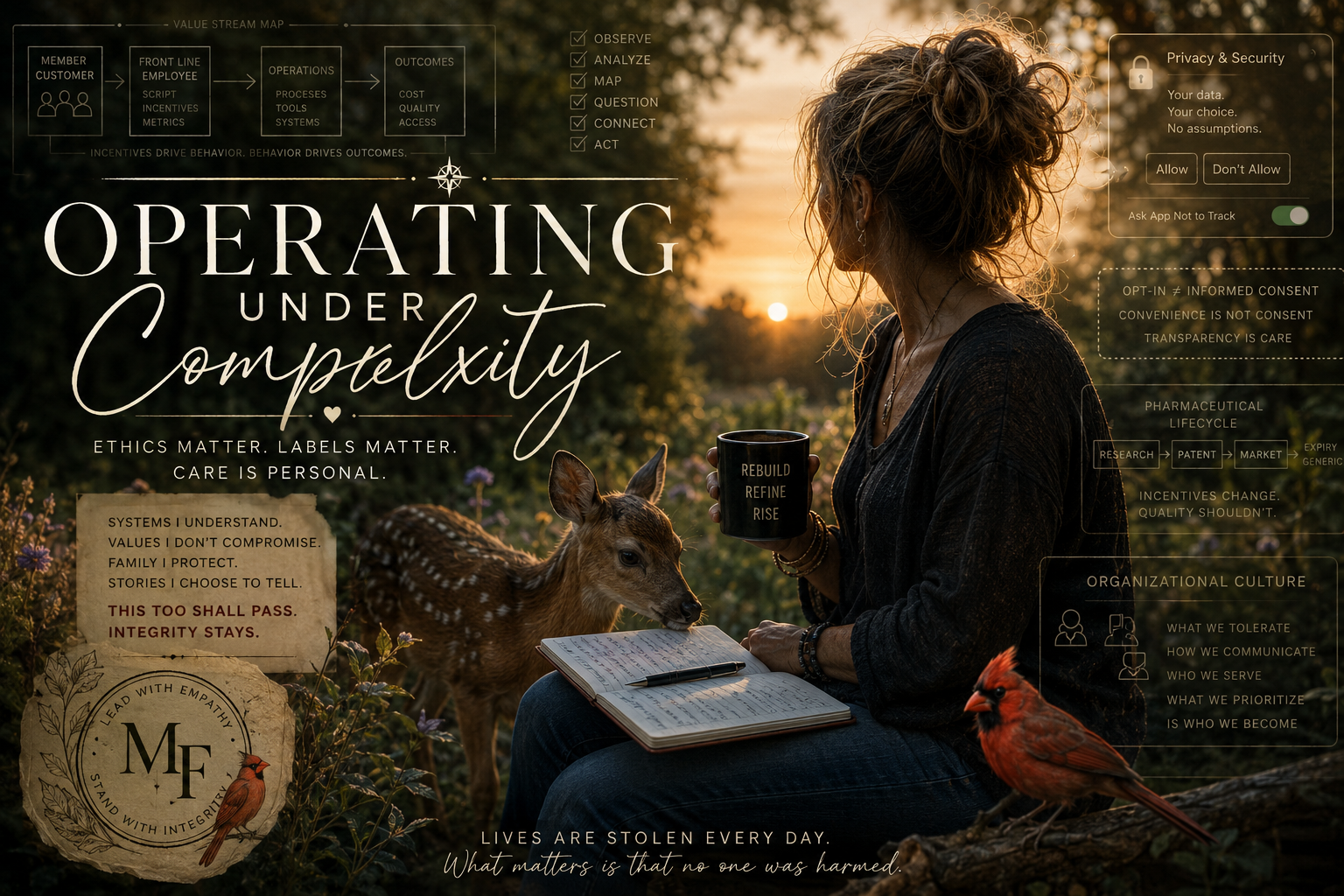
Recently, I posted a photo from a difficult period in my life where I was feeding an orphaned fawn outside a family member’s home.
People responded emotionally to that image.
But the truth is, animals and children have always trusted me.
Babies curl up in my lap.
Kids gravitate toward me.
Friends’ children call me “mom.”
Wildlife approaches me without fear.
Not because I am extraordinary.
Because nervous systems recognize safety long before institutions do.
And that realization has changed me.
The older I get, the less interested I am in polished performance and the more interested I become in transparent congruence.
Not oversharing.
Not spectacle.
Not self-destruction disguised as vulnerability.
Just honesty.
Real honesty.
The kind that says:
- caregiving is hard
- systems fail people
- burnout is not cured with supplements
- labels matter
- ethics matter
- health is personal
- and trust, once fractured, requires action—not branding—to rebuild
That is also why I continue writing publicly.
Not because I need attention.
Because authorship matters.
Stories matter.
Meaning matters.
And because somewhere along the line, many of us stopped distinguishing between human complexity and human danger.
Those are not the same thing.
I recently reflected on something inspired by an old family therapist:
“Are you a charlatan, or are you transparently vulnerable?”
The distinction is critical.
Charlatans manufacture intimacy for influence.
Transparent people tell the truth carefully enough that others feel less alone.
I know which side I stand on.
There is a quote often attributed to reinvention narratives:
there is something liberating about surviving public misunderstanding.
Not because humiliation is enjoyable.
Because eventually you realize that losing image control is not the same thing as losing integrity.
Lives get disrupted every day.
Careers get interrupted.
Bodies fail.
Systems restructure.
Communities shift.
People disappoint each other.
What matters is what happens next.
For me, what happened next looked like:
- remodeling bathrooms
- relearning music
- rebuilding physical strength
- returning to fermentation
- reconnecting with community
- refining my voice
- protecting my family
- and continuing to choose ethics under pressure
That is what “operating under complexity” means to me.
Not predicting disaster.
Not controlling outcomes.
Not proving myself right.
But remaining accountable to my values while navigating uncertainty in public view.
This chapter will pass.
But the lessons are staying with me.
Labels matter.
Equity matters.
Responsible adulting matters.
Ethics matter.
And care—real care—has always been personal.
—MF