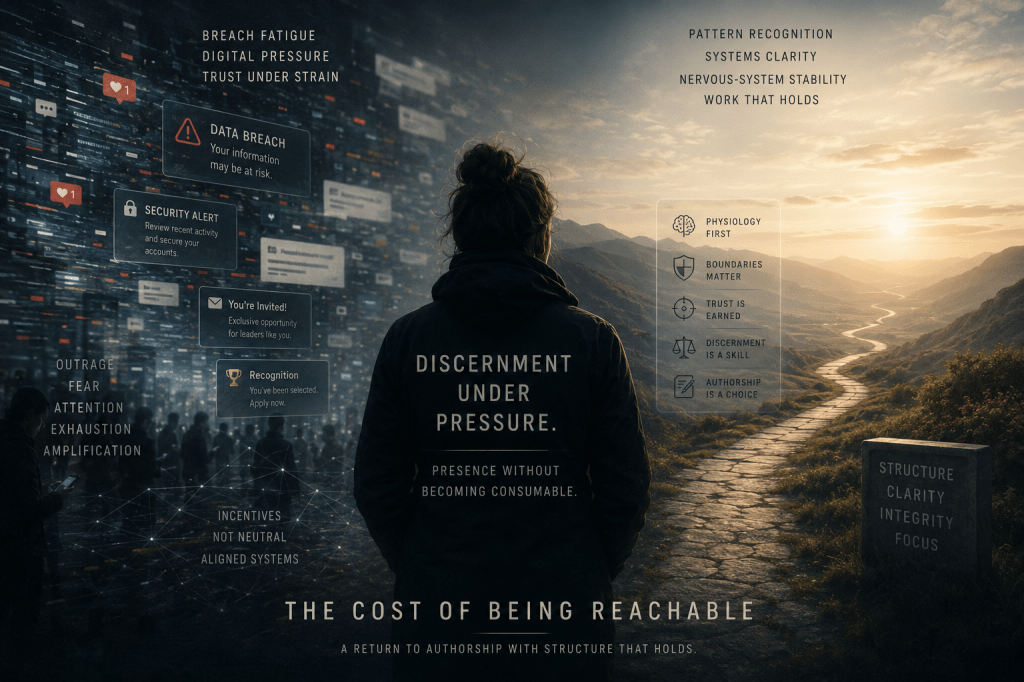
Notes on Breach Fatigue, Digital Pressure, and Modern Trust Systems
The Cost of Being Reachable
Ten weeks ago, I returned from Iceland to a country that felt subtly different than the one I left.
Not just politically. Not just socially.
Nervously.
Within days, a familiar pattern resumed. A data breach notification arrived. Security guidance followed. Then, almost immediately, a different category of message appeared: polished outreach, invitations, recognition offers, and “opportunities” framed in language that sounded official, flattering, and urgent.
None of this is unusual in isolation.
That is the point.
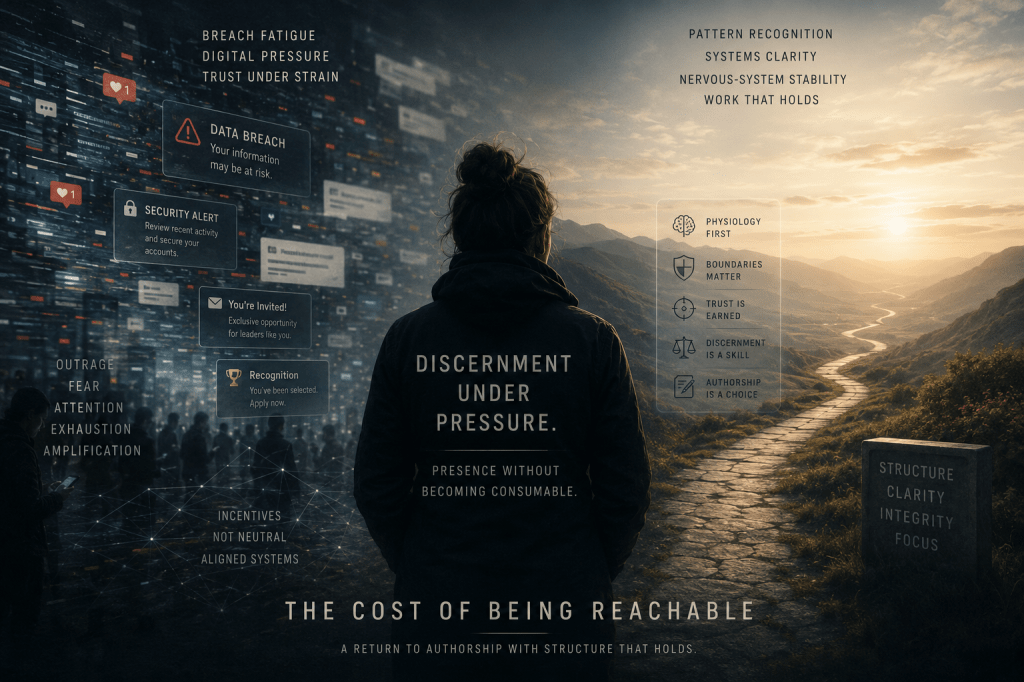
Navigating the new normal: a woman stands between lived wisdom and digital systems, balancing human maturity with data-driven interfaces, decision layers, and complex navigation menus shaping modern life and work.
We are now living inside systems where ordinary people are expected to continuously evaluate:
- what is real versus what is constructed,
- what is safe versus what is extractive,
- what is relational versus what is transactional,
- and what is signal versus noise.
For anyone operating publicly—especially entrepreneurs, caregivers, educators, and independent professionals—this has quietly become a second layer of labor.
Unpaid. Continuous. Cognitive.
Every message becomes a triage event.
Twenty Years After Studying Digital Conflict
In college, I studied global terrorism and digital terrorism during a period when those topics were still largely treated as external geopolitical concerns.
We examined:
- asymmetric conflict,
- propaganda systems,
- recruitment structures,
- psychological influence,
- destabilization strategies,
- and early information operations.
At the time, much of the public conversation focused on foreign actors and state-level threats.
What was less visible then—but is now impossible to ignore—is how many of those underlying mechanisms have become embedded in everyday digital environments.
Not in the form of formal terrorism.
But in structurally familiar patterns:
- attention capture,
- emotional escalation,
- identity manipulation,
- reputational pressure,
- algorithmic amplification of conflict,
- and continuous exposure to uncertainty.
These systems do not require a single coordinating actor to produce destabilizing effects.
They function through incentives.
Systems Under Pressure Reveal Human Systems
Over the past several months, I have experienced significant personal and relational disruption alongside broader systemic stressors.
I have chosen not to publicly detail private relationships or turn personal conflict into public narrative.
What I can speak to responsibly are patterns.
Under sustained pressure, systems tend to reveal their structure.
People do as well.
Some stabilize and become more precise in their thinking and behavior.
Others fragment, withdraw, or disengage.
Some seek control through proximity, narrative shaping, or influence over perception.
Some convert instability into opportunity.
Some prioritize image over accuracy.
And some simply try to survive the cognitive and emotional load of modern life without adequate support.
These are not moral categories.
They are stress responses operating inside constrained environments.
The Feed Is Not Neutral
One of the most profound cultural shifts of the last decade is the collapse of lived experience into mediated identity performance.
Increasingly, people do not simply respond to events.
They curate them.
Every experience becomes:
- positioning,
- signaling,
- narrative framing,
- or identity reinforcement.
Even distress is not exempt.
This creates a secondary pressure layer:
the pressure to be legible to an audience while still trying to remain intact as a person.
Platforms did not invent this dynamic.
But they industrialized it.
Outrage is rewarded.
Fear is amplified.
Attention is monetized.
Exhaustion reduces resistance.
The result is a system where emotional intensity is often more visible than accuracy.
The Nervous System Layer
Beneath all of this sits something less discussed but more consequential: physiology.
Large portions of the population are now operating under conditions of:
- chronic stress,
- financial strain,
- institutional distrust,
- fragmented attention,
- pharmacological reliance,
- substance misuse in some cases,
- and continuous digital interruption.
At the same time, they are still expected to:
- work,
- parent,
- maintain relationships,
- interpret information environments,
- and self-regulate with consistency.
This mismatch is not sustainable.
Schools feel it.
Workplaces feel it.
Families feel it.
Children inherit it.
What we often describe as “social dysfunction” is frequently a downstream expression of nervous-system overload distributed across entire populations.
Another Breach, Another Invitation
Recently, another data breach notification arrived.
Minutes later came a different kind of message: polished outreach, recognition language, and opportunity framing designed to invite engagement.
Maybe it was legitimate.
Maybe it was marketing infrastructure operating at scale.
Maybe it was simply another expression of a system where attention itself has become a resource to be extracted, shaped, and redirected.
But the sequence itself is what matters.
Because it reflects a broader condition:
Many people are no longer exhausted by one thing.
They are exhausted by the continuous need to evaluate everything.
Returning to Work
For the past several months, I have been largely absent from public writing.
Not because there was nothing to say.
But because not every experience is meant to be immediately translated into public consumption.
There is a difference between disclosure and discernment.
I am not interested in converting private disruption into spectacle or performance. The internet already produces enough of that.
What I am interested in now is something more durable:
- pattern recognition,
- systems literacy,
- institutional clarity,
- nervous-system stability,
- and rebuilding forms of work that can hold complexity without collapsing into distortion.
This period clarified something important.
Not only about external systems.
But about the cost of remaining constantly reachable inside environments that are optimized for extraction rather than coherence.
Closing
I do not believe the answer is withdrawal.
I also do not believe the answer is exposure without boundaries.
I believe the work ahead requires something more difficult:
Discernment under pressure.
The ability to remain present without becoming consumable.
And the discipline to rebuild personal and professional systems that prioritize clarity over noise, stability over volatility, and authorship over reaction.
This is a return to work.
But more precisely, it is a return to authorship with boundaries that hold.

 Slingshot Designs