
There is one question that can collapse an enormous amount of noise very quickly:
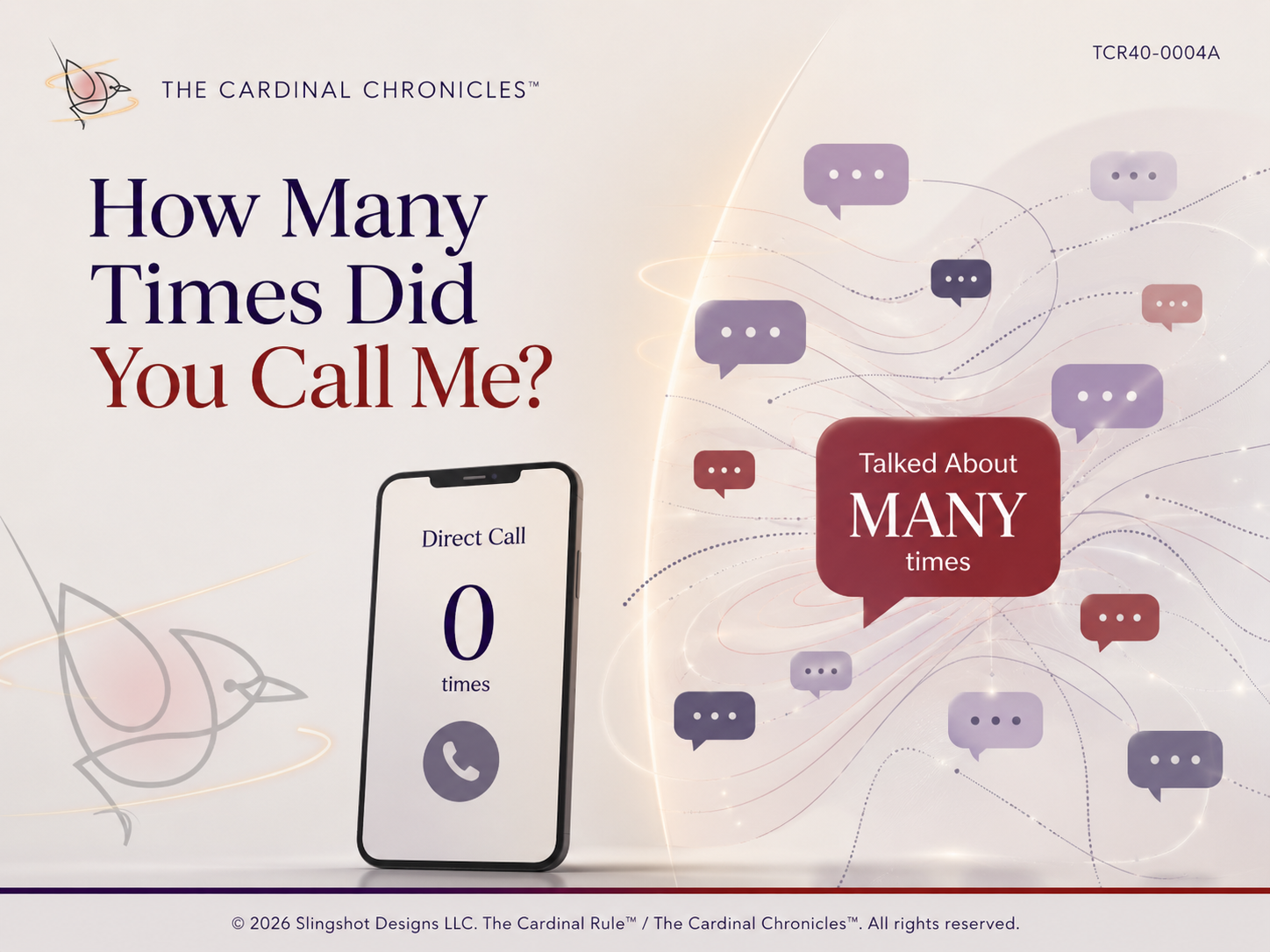
How many times did you call me?
Not how many times did you think about calling.
Not how many conversations did you have with someone else.
Not how many conclusions were formed.
How many times did you go to the source?
Information has a supply chain.
In organizations, we care deeply about source quality. We distinguish between direct observation, verified data, secondhand reports, assumptions, and interpretation because decisions become more fragile as the information chain becomes less reliable.
Human systems are no different.
A statement leaves one person. Another person interprets it. A third person adds context. A fourth person remembers only part of it. By the time it reaches the person making a decision, the story may feel settled even though nobody ever returned to the source.

Call the Board.
Dove asks the relational question first: Was there enough care, trust, or courage in the relationship to ask directly? What did the person at the center of the story experience while everyone else was discussing them?
Owl wants source quality. Who observed what? Who confirmed it? What is documented? What is secondhand? What is inferred?
Peacock traces the transmission network. Who told whom? Where did the language change? Which people amplified the story? Which channels gave it credibility?
Eagle studies the pathway over time. Does the same bottleneck recur? Does information repeatedly bypass the same person? Is there a structural reason this system produces indirect communication?

Cardinal’s question is simple:
Before I evaluate the conclusion, have I evaluated the system that produced it?
Directness is not the same as aggression.
Going to the source does not mean interrogating someone. It can be as ordinary as, “I heard something and I want to make sure I understand before I form an opinion.”
Sometimes direct contact confirms the concern. Sometimes it changes the entire picture. Sometimes there is no safe or appropriate reason to contact the person directly at all.
The point is not a rule that says everyone must talk to everyone. The point is to know the strength of the information you are using.
Field Work: climb the Evidence Ladder.
The Evidence Ladder below is available to free Slingshot members.

Subscribe to continue reading
Subscribe to get access to the rest of this post and other subscriber-only content.