
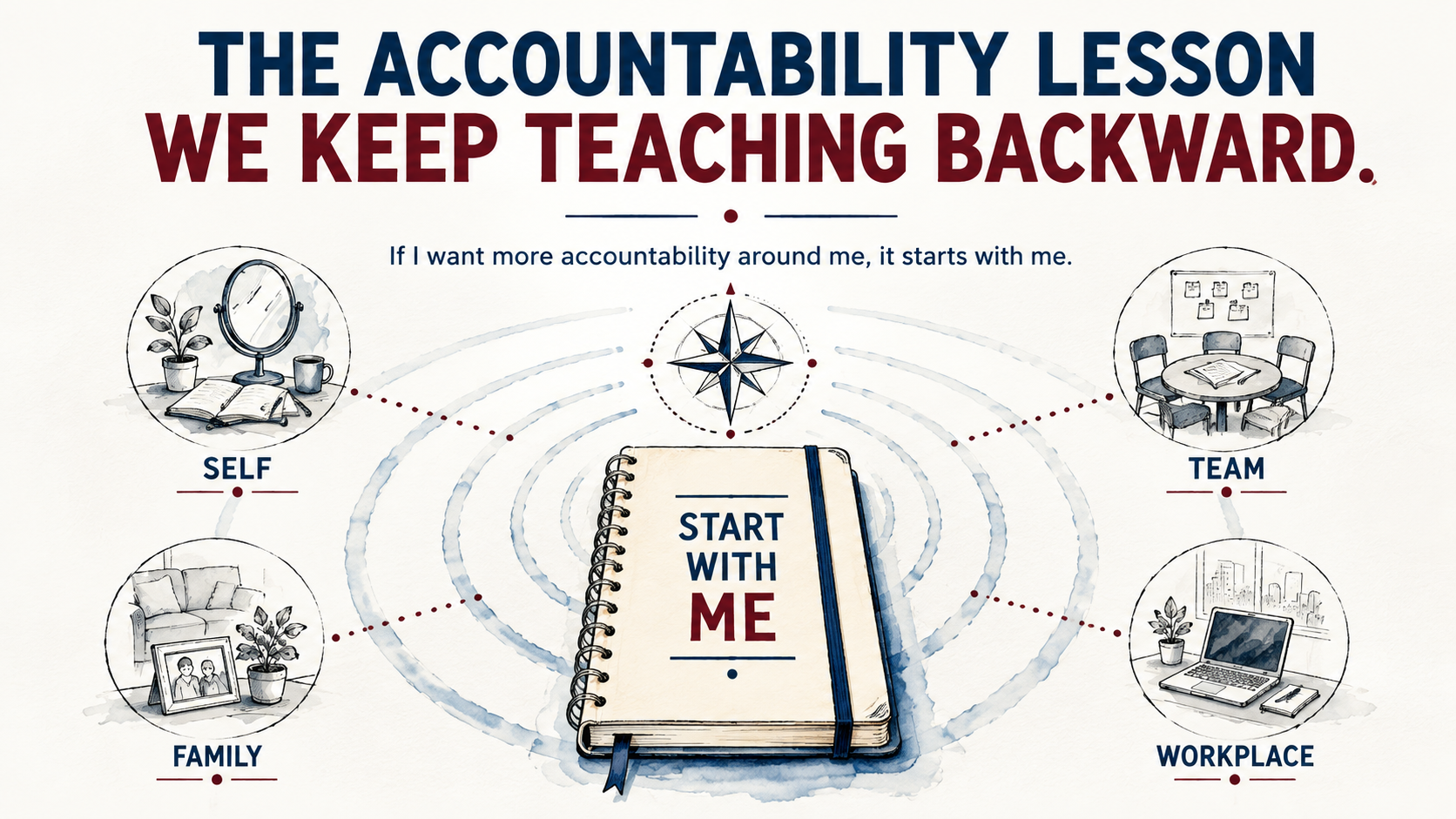

Three different people said some version of the same thing to me this morning:
“I read everything you publish.”
Every time somebody tells me that, I smile a little.
Because I publish a lot.
My website analytics and I have agreed not to interrogate the word everything too closely.
But I know what people mean.
They notice. They stop. Something catches. Something stays with them.
That matters to me because I have been deliberately working on becoming a better writer—not louder, not simply more prolific, but more precise and more useful. Better able to take something complicated that happens between human beings and make the pattern underneath it visible.
And something interesting happens when you write about recognizable human patterns.
People recognize them.
Sometimes they recognize themselves.
I do not generally write about individuals. I write about behaviors and patterns I have watched repeat across workplaces, organizations, families, friendships, institutions and communities.
The names change.
The setting changes.
The power structure changes.
The pattern often does not.
And once you become practiced at recognizing patterns, you stop spending quite so much energy trying to fix each individual occurrence.
You start asking what keeps producing it.
The Accountability Problem
That is where this morning unexpectedly became a leadership lesson.
Because I realized I have spent years teaching something that took me considerably longer to practice consistently myself:
Start from within.
Take accountability.
If I walk into an organization and hear, “My people don’t take accountability,” there are a dozen perfectly respectable things I could recommend.
- Accountability training.
- A workshop.
- A competency model.
- Performance expectations.
- New metrics.
- An ownership exercise.
Some of those things may eventually be useful.
But they are not where I want to start anymore.
Because the first question is not:
How do we make these people more accountable?
The first question is:
What is happening around these people that makes accountability difficult, dangerous, unnecessary or impossible?
And then comes the harder question:
What part of that environment am I creating?
That is self-leadership.
Responsibility Is Not the Same as Blame
It took me a long time to understand the difference between accepting blame and accepting responsibility.
They are not the same thing.
Responsibility does not require me to declare that every bad outcome is my fault.
It asks something much more useful:
What portion of this is mine to influence?
That question has changed my life.
And recently I watched it change my children’s lives too.
I have made some significant changes in my own relationships.
Not because I wanted to teach my daughters a lesson.
Because I needed to change.
I had to look at what I tolerated. What I excused. Where I over-functioned. Where I apologized simply because someone else was uncomfortable. Where I carried responsibility that belonged to somebody else. Where I kept trying to repair relationships that required two people while behaving as though one extraordinarily determined person might somehow be enough.
I did not sit my daughters down and develop a curriculum about any of this.
There were no worksheets.
No accountability buddy.
No PowerPoint presentation entitled Choosing Healthier Relationships: A Mother’s Guide.
They watched.
And then they started making different choices themselves.
Yesterday, while I was telling one of them about the return of a friendship in my own life—a relationship filled with affection, reciprocity, laughter and genuine interest in one another—she hugged me.
“You deserve to have love in your life like this, Mama.”
And I knew something immediately.
Yes.
I do.
But more importantly:
They know they do too.
That Is Leadership
Not telling somebody what healthy behavior looks like.
Not demanding it.
Not assigning it.
Creating enough evidence through your own behavior that another human being can recognize what is possible and make a different choice for themselves.
That is the Cardinal Rule.
And it changes the way I think about accountability completely.
If I want the people around me to take more accountability, I do not begin by teaching them accountability.
I begin by taking more of my own.
If I want candor, I examine what happens when somebody tells me something I do not want to hear.
If I want initiative, I examine whether people actually have enough authority to initiate anything.
If I want people to stop waiting for me to solve every problem, I examine how often I rush in and solve problems for them.
If I want ownership, I examine whether I have given anyone anything meaningful to own.
If I want trust, I look at whether my behavior makes trust rational.
Leadership becomes considerably more demanding when we approach it this way.
It also becomes considerably more effective.
Because now I am working on one of the few variables I can actually control:
Me.
Leadership is not getting other people to practice what you know.
It is practicing what you know until other people can experience the difference.

Subscribe to continue reading
Subscribe to get access to the rest of this post and other subscriber-only content.